
A record-breaking website redesign rescue case study
Client location: Wollongong NSW
- Full digital marketing audit highlighting the sharp decline in website traffic after a new agency built website was launched.
- Engaged to do a complete website redesign and rebuild as well as search engine optimisation and content creation to rescue the lost traffic.
- Organic search recovered to, then surpassed, its previous best levels, ending 2021 as the highest-traffic year in the brand’s history.
- Confirmed bot and link-farm traffic cleaned up, taking real Australian visitors from 6% of all traffic to 67% within a year.
- Paid Google Ads were deliberately stopped once organic search proved to convert better on its own.
- More than 1,172 leads generated and tracked since November 2021.
- The owner told an industry publication the work “made a huge difference… we received perhaps 70 per cent more enquiries”.

Getting the right eyeballs onto our products and delivering quality information to our customers is what they excel in."

A metal civil products manufacturer, supplying councils, government and commercial clients since 1989 engaged me to conduct a digital marketing audit in 2020. What I found was the business had been genuinely let down by different agencies at the same time:
- A 2019 redesign made their organic search performance worse (which I wrote about before) but the owner didn’t know. This is the same pattern I’ve wrote about relating to letting a developer handle a website redesign.
- The marketing agency was reporting “improving positions” with no year-on-year context, while the real numbers showed organic traffic down to its lowest volumes in years. Plus they weren’t looking at the conversion rates of visitor to enquiry, you’d expect a redesign would improve them, it didn’t.
- A Google Ads agency was running specific campaigns with bounce rates to the pages sitting at round 90% so people weren’t even looking at the content & some ads were being sent to URL’s that didn’t exist which meant money was being wasted.
- Underneath all of it, a serious fake traffic problem was quietly inflating the site’s raw numbers and hiding what was actually happening. There was a huge volume of visits originating from Hong Kong and the owner had no idea and the agency wasn’t reporting it either.
What did my digital audit discover?
As a marketing consultant I see this happen all the time.
The business feels like it is time to update the website so they approach either a graphic designer, web developer or an agency to come up with a new design.
What typically happens is that none of them look at the actual content on the site, how it performed, keyword rankings etc so they build something new that ‘looks pretty’ and then launch it.
Most business owners have no idea how to interpret their own website data (neither do most graphic designers, web developers or agencies) so they just assume everything will be fine and more customers will be generated because the site looks better.
Wrong assumption and here is the proof below

The new website looked visually different but lacked any of the critical components needed to either maintain or grow organic search volumes. URL’s, headings, body copy, image naming, meta data – none of it was optimised at all.
Traffic volumes dropped significantly.

I also looked at visitor behaviour and you could see the 55% decline in average visitor time for people visiting on a desktop computer which made up the bulk of their traffic.
So even though the site looked visually different, it wasn’t usable and the average time is proof.

So not only was overall traffic volume dropped due to the loss of organic search rankings, but the visitors who were coming to the site weren’t enjoying using it.
The result was less enquiries coming through so the business owner knew something wasn’t quite right.
Increasing the advertising spend didn’t fix things either, it compounded the problem as they weren’t engaging with the site either.

I cleaned up the overseas traffic first
When the owner told me they had thousands of people visit the website after the new design was launched but not many enquiries I knew something didn’t make sense. The information on the website looked ok & seemed credible, so I wondered if it was real traffic visiting it.
It didn’t take me long to figure out once I compared the traffic sources before and after the website launch.
What was obvious was there were these huge spikes in traffic from ‘Direct’ sources which were unidentified by Google and only spending a second or so on the site. This is a very simple indicator of ‘bot’ traffic which is normally generated from backlinks set up on private link networks and the like. The theory used to be if Google saw lots of links the site is highly credible, but numerous Google Core Algorithms have reduced the impact of this, in fact, Google ignores many of these links as it knows they are from spammy sites.


Agencies and contractors still use this method & in many cases they use the ‘summary’ of a report to hide the true source of them. I discovered this in another case study where an agency charged 000’s for SEO that was basically fake backlink traffic.
So, once the owner was able to digest my digital audit the first decision was to try and at least rescue the Australian visitor traffic.


By January 2021, I’d shut down all the spammy backlink setup that was put in place which was the culprit behind the traffic volumes from Hong Kong and other countries. There were traffic spikes recorded regularly through 2020.
The difference shows up immediately in the data: comparing January to April;
- Australian visitors went from just 6% of all traffic in 2020 (1,456 people) to 67% in 2021 (1,187 people).
- Total volume looked lower, because most of what had been counted before wasn’t real.
- Organic search went from 2.5% of traffic to 50%, and organic search alone accounted for 70% of every genuine action on the site, calls, emails, contact form submissions.
- Paid traffic made up 19% of visitors in the same period.

I was engaged to design and build a new website

The decision was made to engage me to design and build a new website for this B2B business. The strategy was to;
- Retain the visual brand identity
- Revise the structure of the site to display service pages & then products within each service category
- To design a new news/case study/project display section
- To improve the visuals across the website with better quality photography
- To ensure every page was optimised for search engines with a very clear goal to rescue the traffic it had lost with the previous design.
- Make sure it was presented to improve the conversion rate of visitor to lead.
- Improve the usability so that it was easier to navigate on both desktop or mobile phone.
Every page across the entire website was updated and built on WordPress using Elementor including a new menu structure, revised page structure and new URL structure to separate products & other content pages.

I transformed the existing Projects page which had just three posts which were more like news releases rather than actual examples of work completed.
The new projects section was revised so that it could show different types of commissioned works that were completed across different categories.
I then created multiple case study examples using photos and information from the client to demonstrate the expertise the business had.
The site was then set up to display the most relevant case studies on specific product pages to help build trust for visitors browsing their product ranges.

what happened within days of the new site i designed being launched?

Within a few days of launch
The new website I built launched on 1 July 2021. Comparing the Saturday-to-Monday period against the week before:
- Page views up 325% (149 versus 35)
- Average time per visitor up 610%
- Bounce rate improved 29%, down below 60%.
- Comparing just the Mondays: page views up 236%, average time per visitor up over 1,000%, bounce rate improved 35%.
This is a pattern that is common enough in the industry to be worth watching for: some agencies do use a redesign that quietly breaks a site’s SEO as the reason to sell an ongoing retainer afterward so they “discover” and fix problems the redesign itself created. Whether or not that was the actual intent here, the effect on the client is the same either way, paying once for the redesign, then again for the fix.
In this example the business owner chose to engage me to do a complete website rebuild – so new design, correct SEO implementation, transparent tracking & reporting rather than try and resolve it with the previous contractors.
Within a few weeks of launch
Then by 21st July the new site had generated 7 form leads in just 21 days, against 24 form leads the old site had generated across the previous 180 days.

Within a month of launch
By August we were building real momentum;
- Organic search was up 46% to 229 visitors
- Bounce rate down nearly 8%
- Pages per session up 25%
- Average session duration up 61%
- Tracked goal completions up 300%, from 10 to 42.

The previous work I completed to remove all the backlinks from overseas sources continued to improve results and by August 82% of traffic was coming from Australians.

Google Search Console also showed impressions climbing steadily. On their own, impressions don’t mean much, they’re one of the easiest numbers to point to and the least reliable one to celebrate.
A genuine, sustained rise was still worth noting here, real evidence that Google was serving these pages more often than it ever had before, a reasonable early sign the underlying work was heading in the right direction.

Product category visibility grew quickly
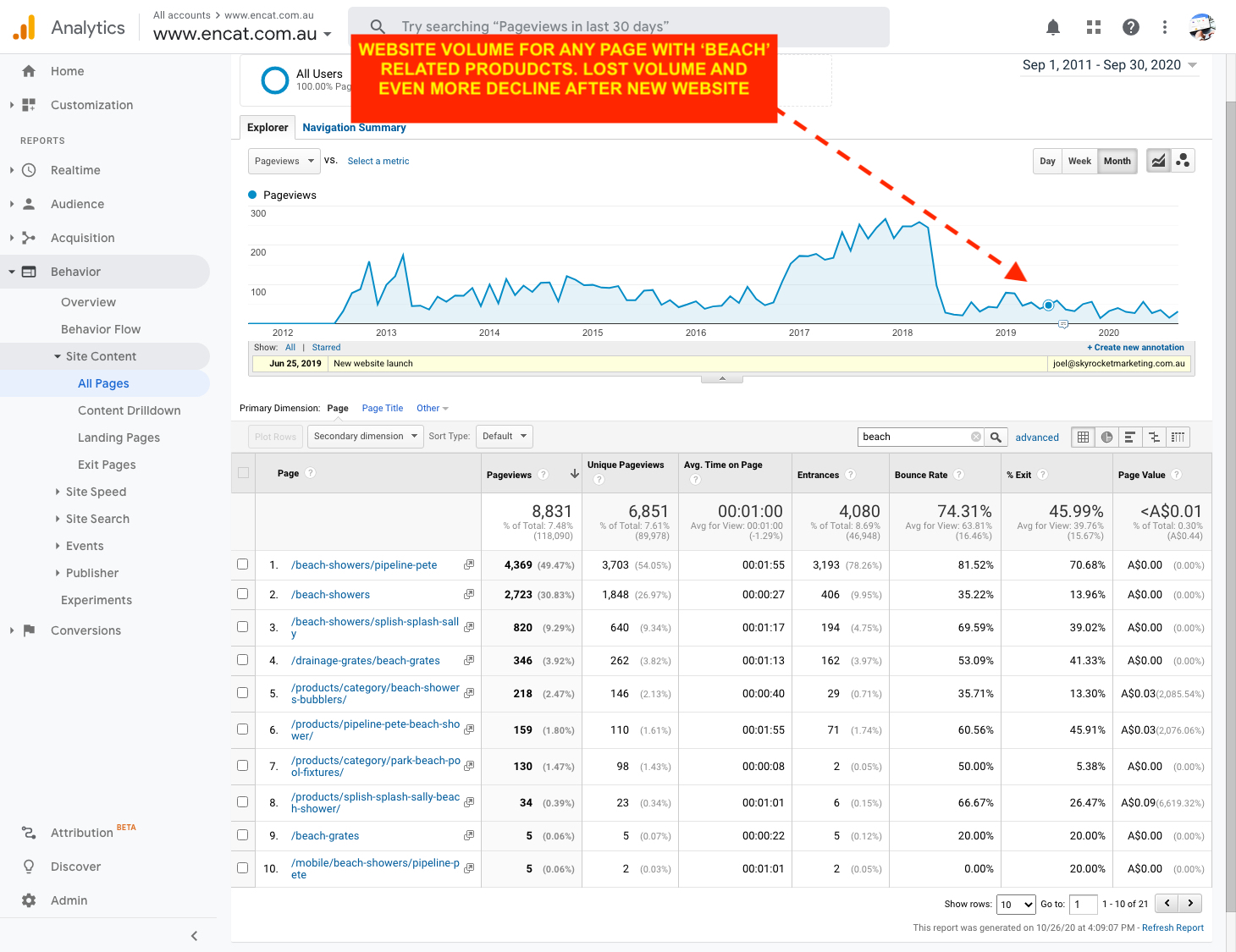
This business had very diverse product categories and some of them had never appeared via organic search at all. One category that did was the Beach Showers but when the agency launched their new website they lost that completely. The new website I built corrected that over time but what surprised the business owner was all the new exposure they were getting.
Products were appearing in featured snippets on Google as well as outranking existing competitors.

Unique products like their range of modular boardwalks were appearing online for the first time in their history which lead to numerous new contracts being won. Categories the owner didn’t even think people would be searching for.

increasing visibility share over competitors

Using SEMRush I also set up visibility tracking against key competitors for keywords directly related to the focus product categories the business wanted to win more enquiries for. The results spoke for themselves as the brand was getting found for a wider variety of keywords and phrases in relation to their competitors.
While not every phrase was in the top 3 positions they did fluctuate month to month and if ongoing SEO was implemented then they could have been improved, but as you will read a bit later in this case study they were too busy to handle more leads!

Recovering, then breaking, the brand's own website traffic record

By the end of 2021, the website I designed and built had recorded the highest traffic of any single year in the brand’s history.
That growth continued through 2022 and 2023.
In March 2022, after ENCAT secured an AusIndustry Manufacturing Modernisation Fund grant, the owner was quoted about the impact of the work:
“[It’s] made a huge difference… we received perhaps 70 per cent more enquiries.”

By March 2022, organic search had recovered to the levels it last saw in 2018, the brand’s previous peak.
- Pedestrian fencing content, ENCAT’s core product line, held roughly the same 20% share of all page views it had at that 2018 peak, but pedestrian fencing pages themselves were up 25%, with an overall 33.4% uplift across the rest of the site.
- Every quality metric moved in the same direction:
- average session duration up 74% to 2 minutes 4 seconds
- pages per session up 11%,
- bounce rate down 7.5% to 64%

Best of all the owner got to see every result with complete access to all the reporting and data. I built a customised dashboard that reported each month on all the key performance metrics that were important to us.
The most significant was that the engagement rate across every traffic source was improving month by month with more enquiries coming in either via phone or the website quote form requests.

Taking over the paid ads, then turning them off
I also took over the Google Ads account from the previous agency who managed to generate just 11 x enquiries.
I rebuilt the campaign and made sure there was very specific clear tracking this time to minimise wasted ad spend.

Running from May 2022 to June 2024, my campaign generated 1,500 visitors on a modest budget with a lower cost per click spend vs the agency campaign. We beat close competitors for exposure and click through rates were very high as well so all the indicators were positive.
I managed to generate 50 x lead form enquiries and 73 x contact page visits specifically for ENCAT’s premium pedestrian fencing product. We didn’t run call tracking so I do not know how many phone calls came from it.
Once we compared the cost of paid ads, the conversion rates & the volumes of traffic coming from organic search we decided to stop running ads completely.


The benefits of using real data
With the improvements to the search engine optimisation of the website came organic keyword ranking improvements which was visible in the traffic growth & leads. What could also be seen is that the site was getting found for hundreds & hundreds of new phrases.
Not all of them were commercially relevant but many were and this information could have been used to improve the content on the existing pages to win top 3 positions on search which would have increased organic traffic volumes even more.

How has the site performed since 2023?

How about 1,172 leads from November 2021 (or highest ever traffic in their history)
Thats the date we started saving lead enquiries so there were plenty more between site launch and November) and that is just the forms I can see completed in the site back end, it doesn’t include phone calls or emails going to the business.
From the initial relaunch there have been a few case studies added but no major rework happened, not because anything stopped working, but because the business was genuinely too busy to revisit the service and product pages using everything the data was starting to show us.
The foundation of what we had built was still growing regardless.
June to September 2023 vs 2022:
- 4,075 visitors, up 41%
- Organic search 66% of all traffic, itself up 41%.
- Average time on site up 3%
- New users up 38%
- Contact page visits up 260% to 430
- 81 enquiry forms submitted, 80% of them from organic search visitors.
June to September 2024 vs 2023
- Organic traffic up another 10%, now 76% of all traffic
- Enquiry forms up a further 6%.
June to September 2025 vs 2024 the first year on year decline
- Traffic down 15.8%
- Organic down 17% to 1,860 visitors
- Though enquiry forms held up far better, down only 6.5%.
June to August 2026 a recovery
- Traffic is up 2.83% to 2,617 visitors
- Organic down slightly at 4.6% but still holding 68% of all traffic.
The only substantial changes made since 2023 have been the product pages were revised to display more like a typical eCommerce website layout. So the content was retained but the way it was displayed was drastically different. I managed the redesign including all the category & URL changes, redirects & revised page layouts. We made sure that traffic wasn’t lost with the change & thankfully it wasn’t.
A few case studies were added over the years and in early 2026, a dedicated website content project for the Bus Shelter product line delivered incredible results for the category which I summarised in the case study.
What the business owner actually said

“The best marketing company I have used in my 35yrs of business. Insightful, honest, years of experience, reliable with a good knowledge of what’s the best value for our marketing dollar.
Getting the right eyeballs onto our products and delivering quality information to our customers is what they excel in.”
John Ford, ENCAT
I replied at the time: “John, it has been fantastic to witness the growth and success of ENCAT over the past couple of years. Hearing you speak about consistent year-on-year growth and being so busy that you struggle to find time to respond to emails is a clear reflection of the momentum you’ve built.”
If your business has been let down by previous agencies and you’re not sure whether your real numbers match what you’ve been told or if the new website that built is getting the same traffic as the old one, get in touch and I’ll show you the actual data with an audit.
I clean up what’s fake before reporting on what’s real, I’ll tell a client to stop spending on ads the moment the data says it makes sense and create content that not only grows traffic but converts leads. If a previous agency’s reporting on your business doesn’t quite add up, see how I could help.