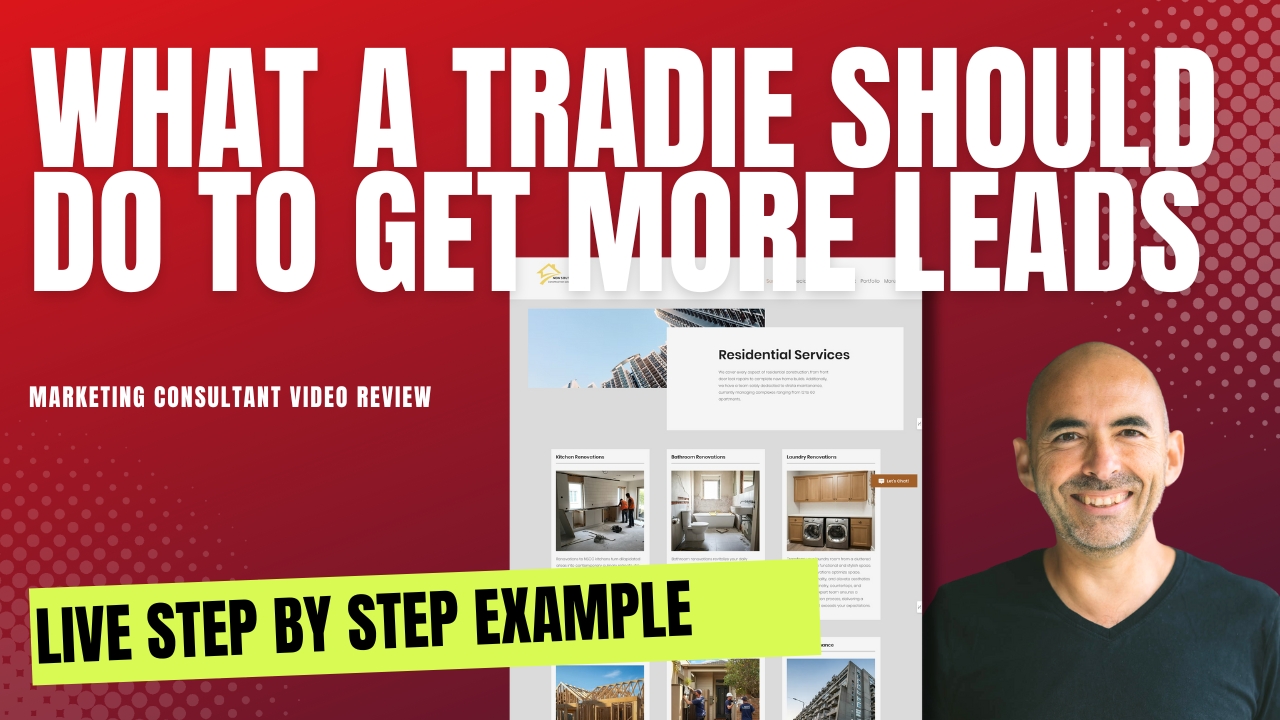
Live review: why I'd refuse to run ads for this tradie business owner
A renovation business in Sydney contacted me wanting more leads: bathroom, kitchen and laundry renovations, targeting homeowners, interested in advertising, social media and SEO. A completely reasonable brief. If they’d engaged me and wanted to start running ads immediately, I would have refused.
Not because I couldn’t have taken the money. Because I’d already looked at their website, and I already knew those ads wouldn’t convert a single visitor into a lead. Charging for a campaign I know won’t work isn’t a quick win, it’s a business relationship that ends in a month with them asking where their leads are. I’d rather say no upfront than take an easy invoice I know is going nowhere.
Here’s exactly what I found, and why it mattered more than any amount of ad spend.
I had to search twice just to find them
The business name wasn’t unique, several similarly named companies came up first. When I did find the right one, a business profile I assumed was theirs turned out to belong to a completely different company. Their Google Business Profile was nowhere to be found under the name on their website.
If a marketing consultant doing a deliberate search has to try twice, a distracted homeowner scrolling on their phone isn’t trying a third time.
The site couldn't decide what it was
- The homepage mixed messaging aimed at homeowners with language like “facility management expert” and “leading contractor,” phrasing built for a commercial audience, not the residential renovation customers the enquiry said they wanted.
- Nobody searches “facility management expert.” People search “bathroom renovator,” “kitchen renovator,” “home renovation contractor.”
- A page trying to speak to both a commercial and a residential audience at once ends up genuinely unclear to both, and if a human reader struggles to work out what the site is about after two passes, a search engine has no chance at all.
The technical basics hadn't been considered either
- One service page had a URL that read “services-9-1”, meaningless to a search engine and to a person glancing at a link.
- The site sent visitors straight to a quote request page with nothing before it to build trust, no proof, no examples, just a stock-style photo and a button asking for a commitment from someone who’d never heard of the business before
- The main call-to-action button was visually lost against the background.
- Competing logos sat awkwardly next to the page’s own heading.
None of this is exotic technical work. It’s the kind of thing that gets caught by anyone actually looking at the page as a first-time visitor would, which nobody apparently had.
The proof that should have been there wasn't
- A portfolio section, empty.
- Project photos that looked like behind-the-scenes shots rather than finished work anyone would aspire to.
- One laundry photo showed what looked like an office desk set up inside a walk-in wardrobe, an odd, slightly disorienting image that may well have been AI-generated rather than a real completed job.
- Blog posts existed but didn’t match the direction the rest of the site seemed to be heading in, almost like two different strategies had been layered on top of each other without reconciling either one.
- Reviews existed too, close to 20 of them, according to their Google profile, but none of that social proof appeared anywhere on the actual website where a visitor could see it.
Why I said no instead of just taking the job
It would have been easy to build a campaign, charge for it, and let the results speak for themselves later. But I already knew what those results would be, because the fundamentals weren’t there to convert a single cold visitor, someone who’s never heard of this business, into an enquiry.
Running ads to a page like that just makes every click more expensive for the exact same outcome: nothing.
That’s not a controversial position, even if it costs a sale in the short term. If a business’s foundations aren’t ready, the honest answer is to fix the foundations first, or say plainly that ads aren’t worth the spend yet, not to run the campaign anyway and let the client find out the hard way three months later.
The pattern behind all of this
Most of what held this business back shows up across almost every trade and renovation business I review:
- A name that’s not unique, or not consistent across the website, social profiles and Google Business Profile
- No visible reviews, licences, ABN or credentials to quickly confirm the business is legitimate
- Stock or AI-generated imagery standing in for real completed work
- Mixed or unclear messaging that tries to speak to every possible customer at once
- Quote or contact pages with no trust-building content in front of them
Fixing this isn’t about spending more on advertising. It’s about getting a Google Business Profile working properly, making sure your name, address and phone number match everywhere you appear online, and building a site around specific services with real proof behind each one, before a single dollar goes toward paid traffic.
If you’re a tradie considering ads or SEO and want an honest read on whether your site is actually ready for that traffic, get in touch and I’ll tell you straight, including if the answer is not yet.
I won’t run a paid campaign for a client when I already know the website behind it can’t convert the traffic. If you want an honest assessment of whether your site is ready for advertising, see how I could help.