How AI search is changing the way customers find your business
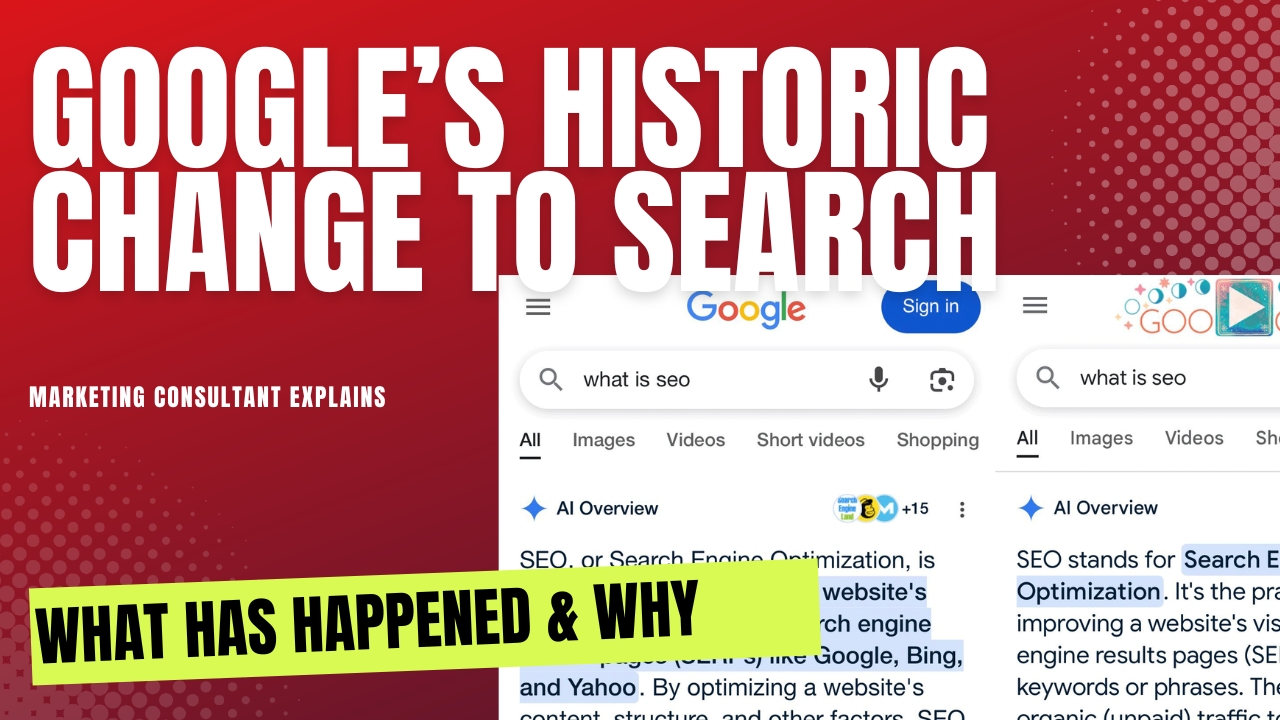
In my view, Google has just made the biggest single change to how people search in more than 20 years. Type in a question now and the top of the results page is increasingly an AI-generated answer, not a list of links. If the answer satisfies what someone was actually asking, they may never scroll down to a website at all, yours or anyone else’s.
If your business relies on leads from your website, that’s worth taking seriously, not as a future risk, but as something already showing up in the numbers.
This isn't theoretical, it's already hitting real businesses, across very different industries
TripAdvisor’s own financial disclosures over the last two years tell a consistent story, not because TripAdvisor is a small business, but because the mechanism is identical regardless of size. In its 2024 results, the company pointed to “continued headwinds impacting free channels, or SEO” as a direct driver of falling click volumes, with Hotels and Other segment revenue down $83 million for the year and segment profit down $61 million.
Through 2025 the picture got worse, not better: full-year Hotels and Other revenue fell a further 8% to $750 million, and by the third quarter, management was explicit that “AI-driven search continues to erode hotel metasearch traffic,” guiding for a mid-to-high-teens decline in that segment through 2026.
The December quarter delivered a 76% earnings miss against expectations, a net loss of $38 million (up from $2 million the year before), and a share price that finished the year down 46%. Marketing spend rose specifically because the company had to start paying for traffic that used to arrive for free through organic search.
TripAdvisor isn’t an isolated case, and it isn’t even the most dramatic one. Several other examples, spanning very different industries and business sizes, show the same pattern playing out.
- Chegg, the online homework help and textbook platform, is probably the clearest documented case of AI search impact anywhere right now. Its own CEO told analysts as early as 2023 that ChatGPT was hurting new customer growth. By 2025 the damage was severe and fully acknowledged in the company’s own official statements: non-subscriber traffic, historically driven by students searching Google for homework questions, fell from an 8% decline in mid-2024 to a 49% decline by January 2025. Subscribers dropped 31% year on year, revenue fell 30% in a single quarter, and the company cut 22% of its workforce in May 2025, then a further 45% of what remained in October.
Chegg’s official statement on the second round of cuts named the cause directly: “The new realities of AI and reduced traffic from Google to content publishers have led to a significant decline in Chegg’s traffic and revenue.” Chegg has since filed an antitrust lawsuit against Google specifically over AI Overviews displaying its content without sending traffic back. A company once valued at $14.5 billion has lost close to 99% of that value.
- Business Insider saw its organic search traffic fall 55% between April 2022 and April 2025, which the company directly linked to cutting 21% of its staff in May 2025.
- Stack Overflow, the largest Q&A platform for software developers, recorded a 35.5% drop in overall visits and a 32.4% decline specifically from Google, as programmers increasingly ask AI coding assistants directly instead of searching for an existing answer on the site.
- DMG Media, publisher of the Daily Mail, reported an 89% drop in click-through rate in September 2025, pointing directly to AI Overviews as the primary cause, one of the steepest single-publisher figures on record so far.
- The Planet D, a much smaller travel blog, lost 90% of its traffic and shut down entirely. Worth sitting with, since it’s the clearest reminder that this isn’t only a large-company problem: independent research from Chartbeat, covering more than 2,500 publisher sites, found smaller publishers losing search referral traffic at roughly 60%, against 22% for the largest publishers in the same study.
Scale and established authority appear to cushion the impact. Smaller, less established sites are being hit hardest of all, which is exactly why the E-E-A-T fundamentals below matter more for a small business than a household name.
Worth being precise about what these examples do and don’t show.
There’s a lot of noise right now about “AI layoffs,” and a meaningful share of it is companies replacing staff with internal AI productivity tools, a real trend, but a completely different phenomenon to what’s described above. Every example here is specifically about AI search and AI chat tools reducing the traffic that used to arrive at a website through search, the exact mechanism this article is about, confirmed in the companies’ own disclosures or independently verified research rather than analyst guesswork.
The same mechanism plays out in far smaller categories. I typed “how can I design my bathroom” and got a complete AI-generated answer immediately, with suggestions and follow-up options, no click required. For a lot of the questions people ask, that answer is enough. That’s exactly why genuinely high-quality, in-depth, specific information on your own website matters more now, not less, it’s the thing that gives someone a reason to click through instead of stopping at the summary.
What actually determines whether you show up in the answer
None of this is a theory I’ve invented. Google publishes the actual guidelines its own human quality raters use, and the update history shows exactly this shift happening in real time: Google added the “Experience” component to E-A-T in December 2022, simplified how raters judge whether a page genuinely meets what someone was searching for and added guidance for modern content formats in November 2023, and most recently, in September 2025, expanded its definition of generative AI content, added specific AI Overview rating examples, and tightened requirements for Your Money or Your Life (YMYL) topics, a change independently reported on by Semrush as well. Google typically revises these guidelines roughly once a year, and every revision so far has moved the same direction: toward rewarding demonstrated, verifiable expertise, and away from content that only looks the part.
Google has also started being far more direct about what actually separates the two.
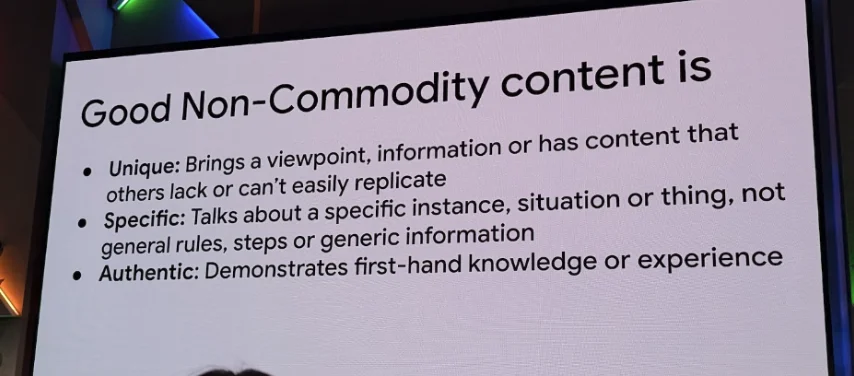
In May 2025, Google’s John Mueller told creators to focus on producing “unique, non-commodity content that visitors from Search and your own readers will find helpful and satisfying.” Then, at Google’s first-ever Search Central Live event in Canada, held in Toronto on 21 April 2026, Google’s public search liaison Danny Sullivan set out exactly what non-commodity content means: unique, bringing a viewpoint or information others can’t easily replicate, specific, about a real, particular situation rather than generic rules or steps, and authentic, demonstrating genuine first-hand knowledge.
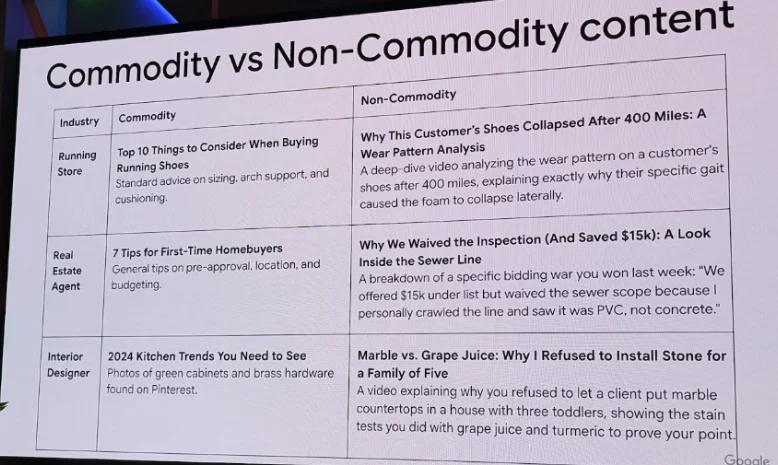
The example Google used on stage makes the distinction concrete: “Top 10 Things to Consider When Buying Running Shoes” is commodity content, anyone could write it. “Why This Customer’s Shoes Collapsed After 400 Miles: A Wear Pattern Analysis” is not, nobody without that actual customer, that actual pair of shoes, and that actual analysis could have produced it.
Full coverage of the talk here, including photos of the original slides. That’s the exact standard every case study, every specific number, and every real client story in this article, and across this whole site, has been built around.
Worth knowing too: ask four or five different AI tools the same question and you’ll likely get four or five different answers. Ask the same tool the same question again tomorrow, and it may answer differently again. Nobody, including people who work in this every day, has a fixed playbook for this yet, because it’s changed enormously in the last twelve months alone.
To further illustrate how big this change is, Google have even updated their Developers Documentation to cover the topic of Optimising your website for generative AI features on Google Search
Real evidence it can work in your favour
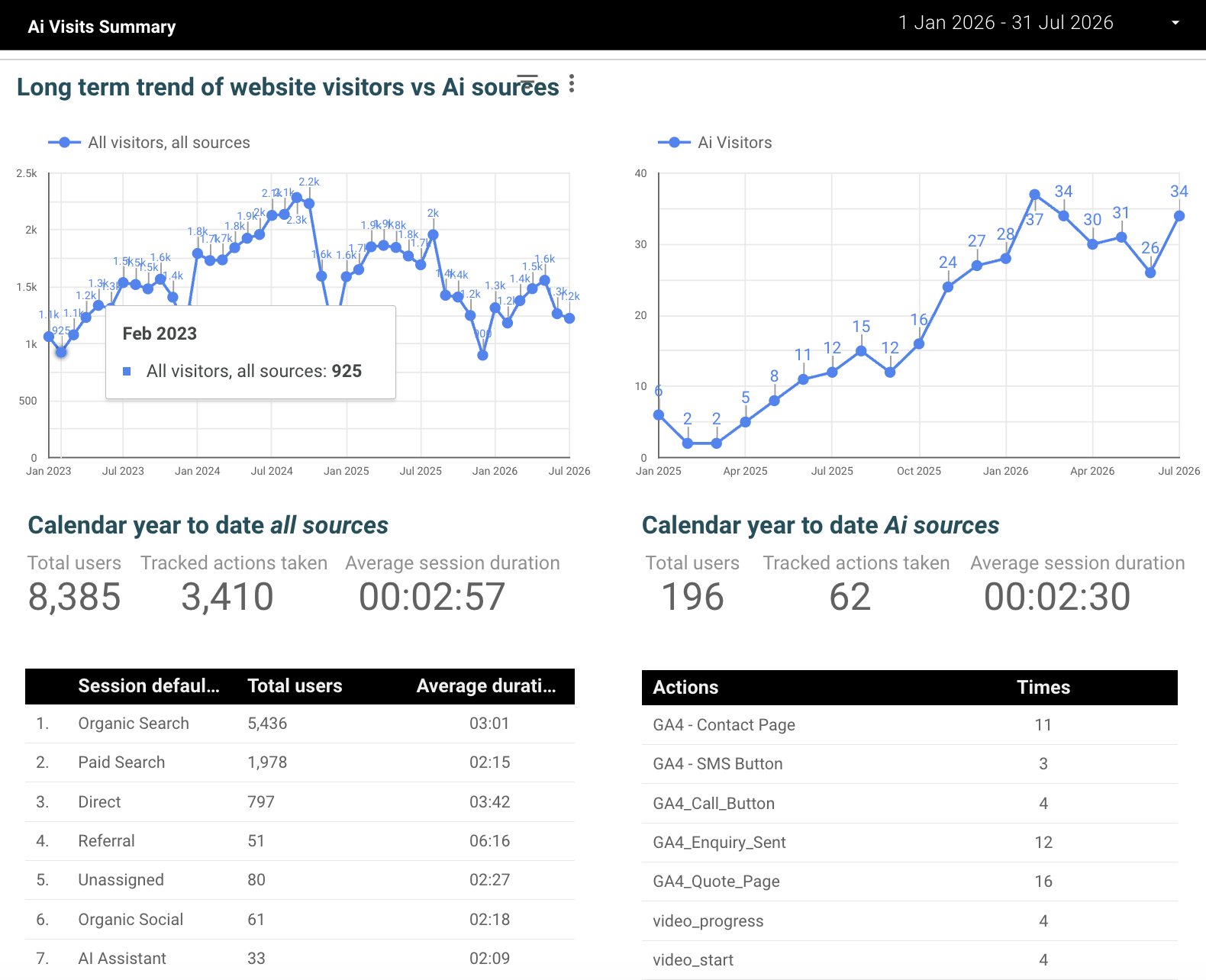
One of my clients has seen consistent growth in AI-driven traffic since the start of 2025, tracked separately from their regular organic search numbers. Their lead capture forms record traffic source, and ChatGPT has started showing up regularly as where a genuine lead came from. Out of roughly 200 people who arrived that way, around 62 took some kind of action on the site, filling in a form, calling, clicking through, close to one in three. That’s a strong result for what’s still a new and unpredictable channel.
Their site runs a couple of hundred pages of content built up over a long time, which is really the point: quality and depth compound. During a live walkthrough recently, I searched a query related to bathroom renovation and one of my client’s own articles, written a while ago about making a small bathroom feel bigger by moving a wall, showed up directly inside an AI-generated answer.
Nobody built that page with AI search in mind. It’s simply specific, genuinely useful content, and AI systems are now surfacing exactly that kind of material when they put an answer together.
Google is starting to show this data, but not all of it yet
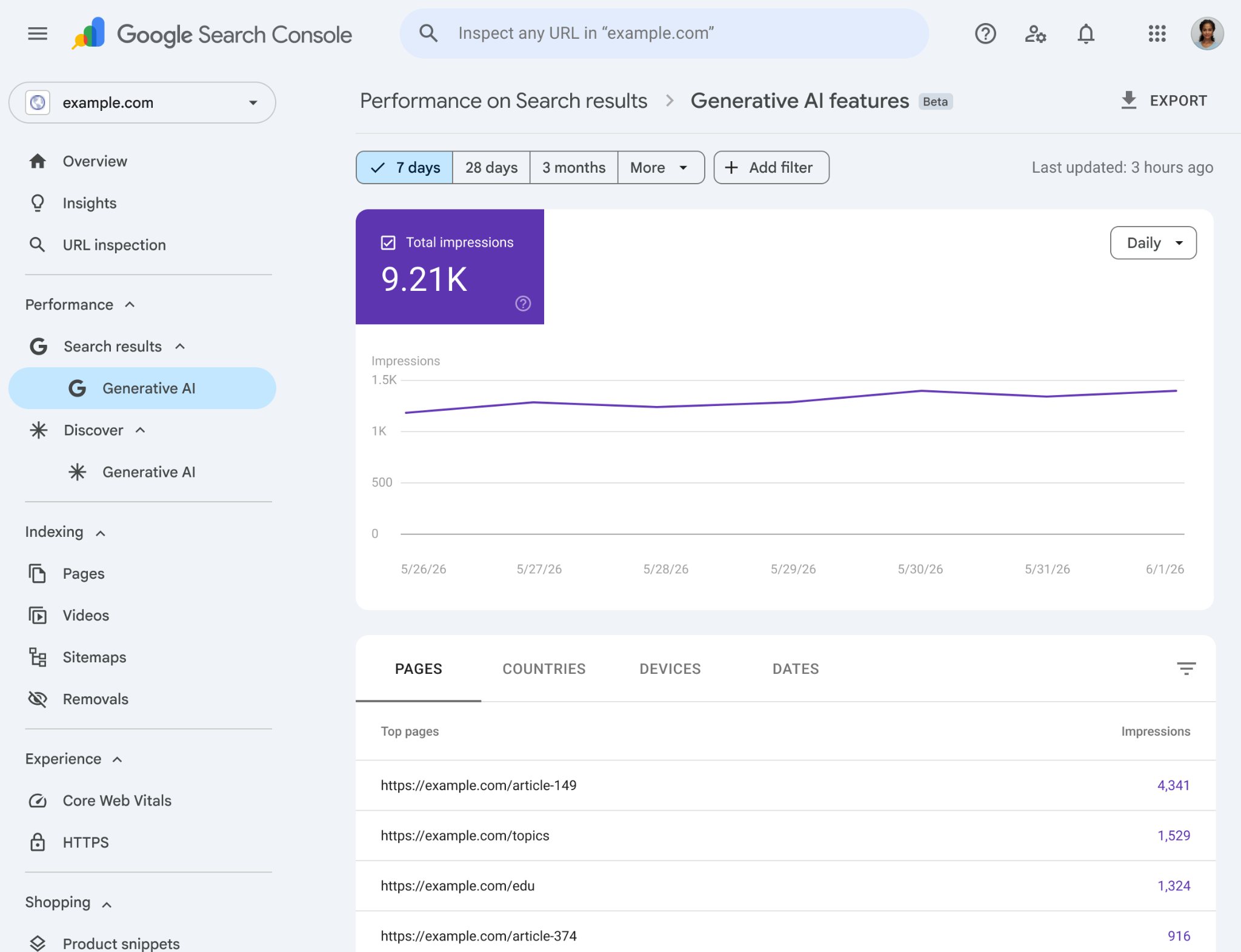
On 3 June 2026, Google launched a dedicated Generative AI performance report inside Search Console, breaking out impressions specifically from AI Overviews, AI Mode and AI-driven Discover features, by page, country, device and date. It’s a genuine, useful first step to understand if and how a website is showing up in Ai derived searches.
It’s currently rolling out to a subset of UK site owners first, with no confirmed date for a wider release, and critically, it shows impressions only, not clicks.
You can see how often you’re appearing inside an AI answer, but not yet whether that appearance is actually sending anyone to your site. Google has said more metrics are coming, clicks are the obvious, most requested gap that everyone is asking for.
What actually still matters
Underneath all of this, the fundamentals haven’t changed, they’ve just become more important.
Can you clearly explain what makes you different?
Can you actually prove what you deliver, rather than just claim it?
Do you have genuine reviews and a track record other people can verify?
Vague, generic content and unproven claims are exactly what gets skipped over by both a human skimming quickly and an AI system deciding what’s worth citing.
My honest view: your existing referral base and your email list are likely to become two of your most valuable assets over the next 12 to 18 months while all of this keeps shifting. They’re relationships you own directly, not visibility you’re borrowing from a platform whose algorithm can change overnight, and I’ve made this same point about why owning your own platform matters more than renting one elsewhere on this site. If you have the budget to advertise directly to people too, that remains a reliable way to reach them regardless of how search continues to change.
If you want to know whether your business is showing up in AI search right now, and what it would take to improve that, get in touch and I’ll show you the real data.
I track AI-driven search traffic separately for clients now, because it behaves differently to regular organic search and deserves its own read. If you want a straight answer on how AI search is affecting your business, see how I could help.