

A real website audit and what actually got fixed
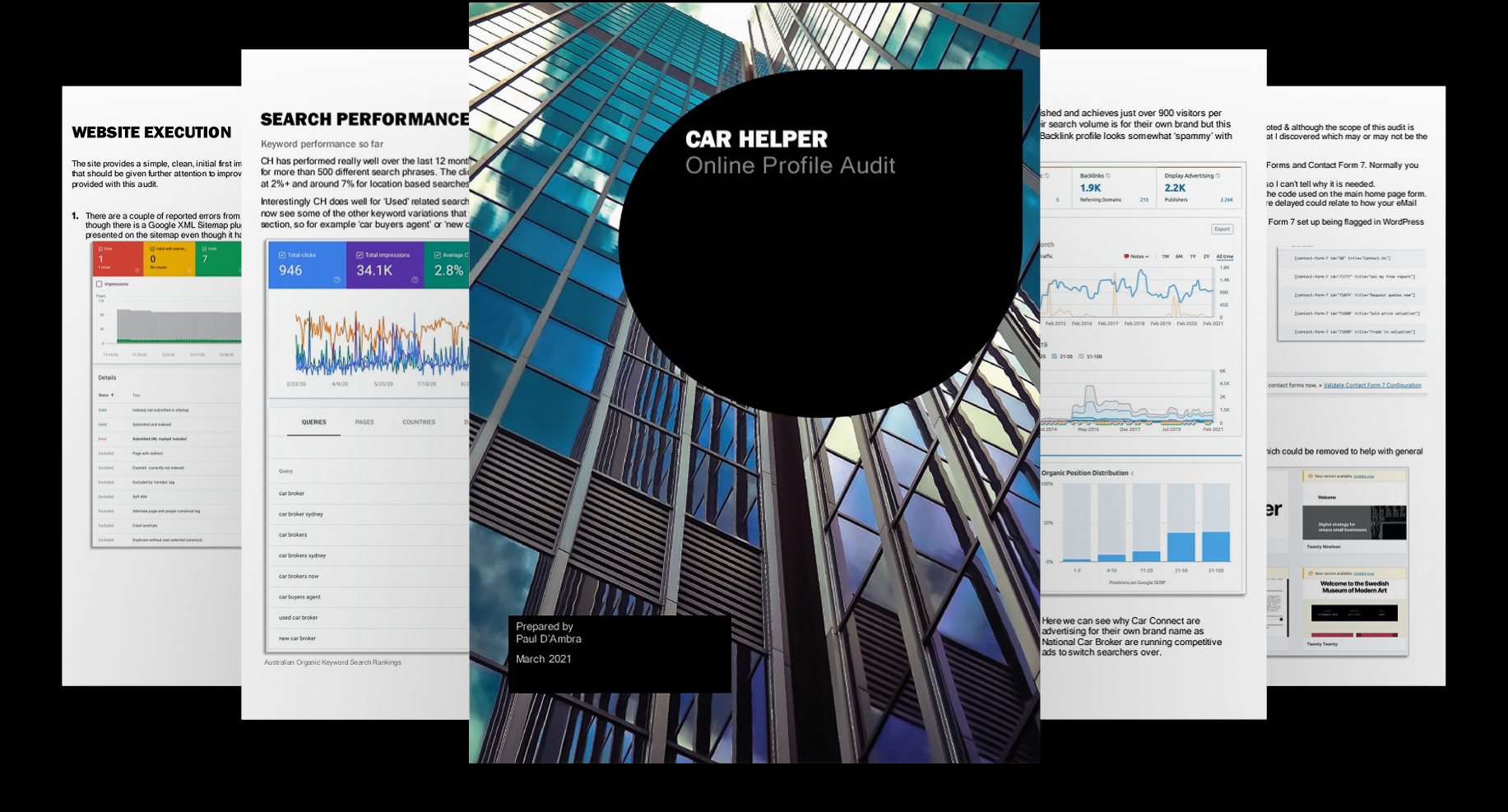
In March 2021, a Sydney car broker asked me for an online audit. I spent real time on it: search volume research, a full competitor teardown, a technical crawl of the site, conversion data analysis. They read the report and decided not to proceed. That happens, not every audit turns into an engagement, and it doesn’t make the work less real.
Recently I went back and looked at the live site again, years later, out of genuine curiosity. The core visual design and structure are essentially the same as they were in 2021, no rebuild, no repositioning. But a handful of the specific things I recommended have quietly been added since, independently, with no involvement from me. That’s worth walking through properly, both as a real example of what a marketing consultant actually checks, and as an unusually clean, delayed confirmation of whether the original advice held up.
What the business was already doing right
Worth starting here, because an audit isn’t just a list of problems. The business had a genuinely strong conversion rate, around 5% of visitors turning into enquiries, and more than 20% of those enquiries converting into paying clients. That’s a real signal of expertise and trust once someone actually engaged with the business. The actual opportunity was never “fix a broken business.” It was “this converts well already, now get more of the right people to it.”
What I actually found
- Traffic almost entirely dependent on the brand name. The site ranked for 500+ search phrases, a genuinely solid number, but the overwhelming majority of clicks and conversions were happening on branded search, people who already knew the business by name. Non-branded, category-level search wasn’t being captured anywhere near as well.
- A PageSpeed Insights score of 27 out of 100. A real, measurable technical problem, though worth being precise about what that does and doesn’t mean: fixing speed alone wouldn’t fix conversion or usability issues layered on top of it.
- No conversion tracking set up at all. More than 60% of traffic was organic search, but there was no way to actually confirm which channel was producing the enquiries, an assumption standing in for data.
- A technical mess underneath a clean-looking front end. Two separate form plugins active simultaneously, one of them apparently doing nothing. A broken-link report showing 3,000 flagged items on a site with a handful of pages, wildly inconsistent with what Search Console itself was reporting. A sitemap showing only 2 pages despite 8 being indexed. More than 20 active plugins for a site that needed a fraction of that.
- A backlink profile that was genuinely thin. The site’s closest direct competitor had roughly 1,400 backlinks. This site had a handful. Backlinks remain one of the clearest signals Google uses to judge a site’s authority, and the gap here was stark.
- No FAQ section, no dedicated reviews page, no blog or content strategy at all. All genuinely low-effort, high-value additions that were simply missing.
The methodology worth actually teaching here
Beyond the specific findings, a few techniques from this audit are worth explaining properly, because they’re genuinely underused by most business owners.
- Mining “People Also Ask” and “related searches.” Every Google results page carries a free, direct, verbatim record of what real people are actually asking about a topic. Each question is a potential piece of content. This is customer research nobody has to pay for, sitting in plain sight on every search results page.
- Using industry-specific data sources for content ideas. For a car broker, VFACTS (the industry’s official new vehicle sales reporting) shows exactly which models and categories people are actually buying, real demand data that can shape which comparisons, savings breakdowns or guides are worth writing.
- Comparative competitor analysis, not just “are they above or below me.” Looking at where a competitor’s traffic actually comes from often reveals a specific weakness worth exploiting. In this audit, one direct competitor was found to be running paid ads on its own brand name, a defensive move that only makes sense once you discover a rival was bidding on that exact brand term to intercept their traffic. Neither fact is visible without actually digging, and together they explain a competitive dynamic invisible from the outside.
What's actually changed on the live site since
This is the part worth being precise about, since the honest answer sits in the middle, not at either extreme. The core design, layout and positioning are essentially unchanged, this was never rebuilt or repositioned. But several of the specific, itemised recommendations from the original audit are now live:
- A working FAQ section now exists, in a clean question-and-answer format consistent with how schema markup is typically implemented, directly matching the original recommendation to build one out
- A blog is now live, with genuinely current content, not an abandoned experiment
- Named customer reviews are now displayed directly on the page, addressing the original “add a dedicated reviews page” recommendation
- Media and press credibility logos have been added, addressing the original point about building third-party credibility signals
- Tracking infrastructure (Google Tag Manager) is now installed, suggesting the conversion-tracking gap has likely been addressed, something genuinely impossible to know back in 2021
What I can’t verify without deeper access, the plugin count, the current PageSpeed score, the sitemap accuracy, the backlink profile, may well still reflect the original technical debt. The visible, content-level recommendations are the ones that clearly landed.
Why this is actually the interesting part
Nobody came back to tell me any of this got implemented. There’s no ongoing relationship, no invoice, no credit sought or given. Someone, whether the owner themselves or someone they brought in later, independently arrived at several of the same specific conclusions a proper audit reached years earlier, and acted on them.
That’s a genuinely clean, delayed validation of the original diagnosis: not because I said so, but because the same gaps got noticed and closed by someone else entirely, working from scratch.
It’s also a real answer to a fair question: does a paid audit actually hold up if the business doesn’t act on it immediately? In this case, years later, parts of it clearly did.
If you want a real, detailed audit of where your own site’s traffic and technical setup actually stand, get in touch and I’ll show you exactly what I’d check.
I audit every site the same way, real search data, a genuine technical crawl, and a proper competitor comparison, whether or not it turns into ongoing work afterward. If you want an honest, detailed read on your own website, see how I could help.