
How much should domain name registration really cost a business?
Domain name registration should cost around $20 to $30 a year for most names. Unusual cases, very popular or generic words, brands, single dictionary terms, can run anywhere from $100 to $10,000.
Outside of that, there’s no good reason to pay more.
I know because I’ve been targeted myself. After registering a domain, I received letters in the mail asking for nearly $100 for something that normally costs $20 to $30. Companies built entire business models around exactly this gap between what people expect to pay and what they can be talked into paying. What’s even worse is that some of these are not for the actual registration, but rather, just to receive a reminder about renewing, yes, an admin reminder.
As a marketing consultant, I’m often asked to help come up with domain name ideas as one of the first steps in a new digital marketing strategy, before a website design even starts. Search engines have evolved enough that a domain name matters far less to your ranking than the content on the site itself, which makes it even less justifiable to overpay for one. If you want the full breakdown of when a domain name actually is worth paying more for, I’ve written about that separately here.
This isn't a hypothetical risk, it's a proven one
In 2018, the ACCC investigated and successfully penalised Domain Name Corp and Domain Name Agency $1.95 million see the official announcement for sending approximately 300,000 unsolicited notices to businesses between November 2015 and April 2017, designed to look like renewal invoices for a business’s existing domain.
They weren’t renewals. They were offers to register a new domain, priced between $249 and $275, against a genuine cost of around $20. The ACCC’s own reporting on the practice noted:
“In 2016, the ACCC received over 100 complaints from small businesses that received similar letters and paid not realising what they had paid for. Some mistakenly thought they were renewing their current domain name and risked missing the genuine renewal notice.”
If you receive anything that looks like a domain renewal notice, check it against your actual registrar before paying anything, and report it to the ACCC’s Scamwatch if it looks like this.
What domain name registration actually is

A domain name registrar is a company accredited to manage the reservation of internet domain names, operating under the rules of the relevant top-level domain registry. Most also offer hosting, customer service, local data centres and SSL certificates alongside the registration itself.
You buy the name from them, then use it to build a website, set up email addresses, or connect a hosting plan.
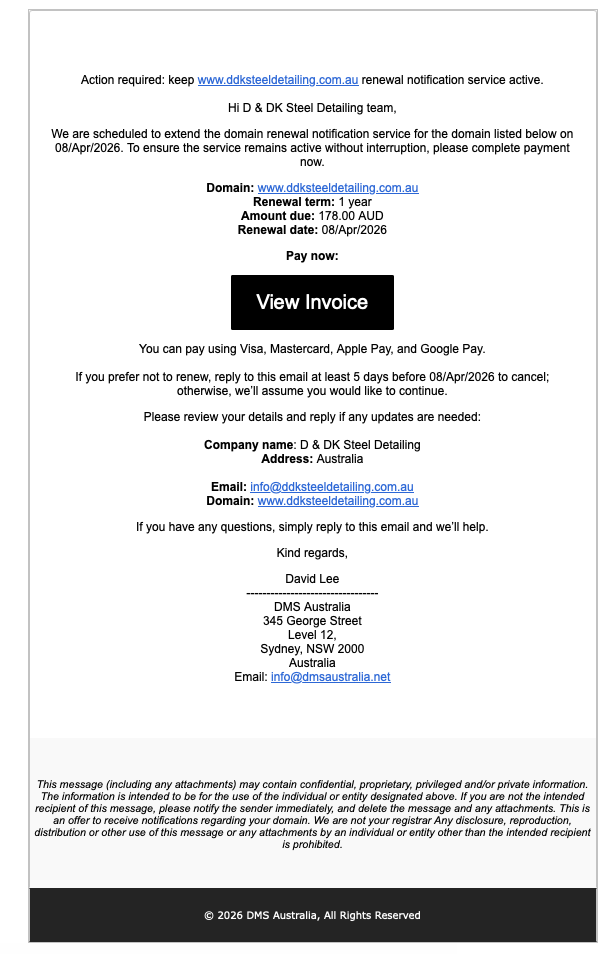
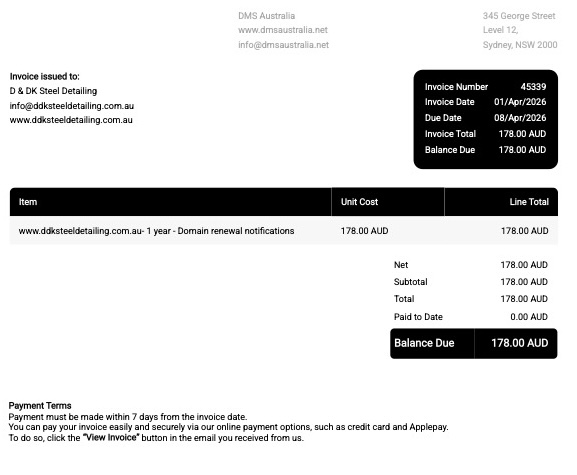
In the examples below, one of my clients had received a ‘domain renewal notification‘ request, notice the wording. It doesn’t say ‘domain name registration renewal‘ so if accepted they would have paid to receive a notice to remind them to renew rather than paying for an actual renewal.
Yes, paying to get a reminder notice.
When you actually need to register a domain
If you’ve been trading under an existing business name for years, registration is usually simple, nobody else wants that exact name. If you’re building a new brand or entering a competitive category, the name you want might already be taken, which is why it’s worth checking domain availability at the same time as testing potential business names, not after you’ve already committed to one.
It’s also common to register a few close variants of your main domain, the .com alongside your .com.au, for example, purely to stop someone else buying and misusing them. You don’t need to use every version, just own them.
The three things people confuse

- Domain name: the actual URL, mybusiness.com.au, that people see and type. There are hundreds of registration companies, GoDaddy, CrazyDomains, Netregistry and others, all selling names for a year or more at a time, and all of them will then try to sell you hosting and email services on top.
- Website hosting: separate from the domain itself, this is the actual storage and computing power that makes your website accessible online. Registering your domain with the same company as your hosting is usually simpler to manage long-term, but not compulsory.
- TLD (top-level domain): the .com, .com.au, or .business ending. If someone already owns mybusiness.com, you may still be able to register mybusiness.com.au. Where possible, secure the variants that matter so a competitor or opportunist can’t sit on them.
Once these are sorted, you can set up a proper business email address (info@mybusiness.com.au) instead of a free Gmail or Outlook account, which matters more for credibility than most business owners realise.
What I actually paid, versus what I was offered
When I registered www.la-lente.com.au (the hyphenated version was already available, the non-hyphenated one wasn’t), two companies wrote to us directly offering to sell us the alternative version:
- $99 – Registry Australia
- $80 – New Domain Services
- $20 – Siteground
- $17 – CrazyDomains
- $16 – GoDaddy


A quick search and we registered it for $20 through our existing host, saving over $70 and keeping everything, hosting, domain, email, with one provider and one support team we already used regularly.
The pricing gap between the unsolicited offers and the open market wasn’t a coincidence. It’s the same model the ACCC penalised Domain Name Corp and Domain Name Agency for: rely on a business owner not knowing the real market price, and charge whatever the letter can get away with.


The pattern to watch for
Genuine renewal notices come from your actual registrar, referencing the domain you already hold, at a price close to what you paid last time. Anything else, a new company you don’t recognise, a price well above $30, wording designed to look like an official renewal rather than a new offer, deserves a call to your existing registrar before you pay it.
If you’ve received something that looks like this, or you want a second opinion before registering or renewing anything, get in touch and I’ll tell you straight whether it’s a fair price. I check pricing and legitimacy the same way for every client, domains included, comparing what’s being offered against what the open market actually charges. If you’ve been sent a domain invoice that looks off, see how I could help.
Related reading on domains:
- Is it worth buying an exact match domain name?, what actually happens when someone tries to sell you a “premium” domain, and how to check if the price is justified.
- Why you keep getting emails offering website help, the same “official-looking, unsolicited, priced to catch you off guard” pattern shows up constantly outside of domain names too.