Why business owners only execute half their marketing advice
If you’ve ever paid for a marketing audit, a strategy session, or a set of recommendations, and you know, deep down, that you only actually acted on the parts that felt manageable, this is worth reading. It’s not a rare failure. It’s close to the norm, and I’ve now watched it happen closely enough, on a business I audited myself, to explain exactly what it costs.
In September 2020, I audited a Sydney and Melbourne intellectual property law firm’s website. Like a car broker I audited the following year, they read the report and didn’t engage me to help. Recently I went back and looked at the site again. What I found is a genuinely interesting, a real example of exactly this pattern: they acted on the recommendation that was easiest to execute and left the rest of the report sitting exactly where it was in 2020.
What the original audit actually found
- The site read as “an online, static business card,” in the audit’s own words at the time, a profile people might refer to rather than a tool actively winning new clients
- Traffic almost entirely dependent on the brand name. Close to 4,000 search impressions across nearly 200 keywords, but almost no non-branded clicks actually landing on the site
- A generic, undifferentiated pitch, the kind of language that could sit on almost any competitor’s homepage in the category
- No testimonials, no case studies, no examples of actual work completed, a genuine, specific gap for a professional services business where trust is the entire sale
- A messy technical foundation, broken sitemap reporting, no robots.txt file, duplicate H1 headings, awkward URLs, unoptimised images
- Thin content, service pages averaging under 200 words, against research showing pages that actually rank averaging over 1,400
- A weak backlink profile, a handful of links against a direct competitor’s several hundred
What they actually did with that report
Years later, the site was completely rebuilt. New theme, new structure, the old messy URLs gone entirely. That’s substantial work.
The single specific recommendation I made that got acted on was adding real, named client testimonials which anchor the homepage. Not generic quotes, actual named companies, including a publicly listed medical technology company, with detailed, specific praise.
That was the clearest, most obvious gap in the original report and it’s genuinely well executed now.
Whether anyone will see it is another story completely.
Everything harder than that seems to be untouched.
There’s no case studies section anywhere on the site, nothing showing the actual work behind those relationships, what the problem was, what was done, what it achieved. The core positioning is still generic, close to word-for-word what the 2020 audit flagged as indistinguishable from every other firm in the category.
Content has effectively stopped: two blog posts in the nearly five years since November 2021 and no demonstrable thought leadership from any of the staff to help showcase expertise or authority.
Why this is exactly what usually happens
Adding testimonials to a page is an admin task in many respects. Someone collects a few quotes, a developer drops them into a template, it’s done in an afternoon.
Rebuilding your core positioning, writing genuine case studies, publishing new content regularly, none of that is a task. It’s an ongoing discipline with no obvious finish line, which makes it exactly the kind of work that quietly falls off a business owner’s list the moment something more urgent shows up. It always does.
That’s not a criticism specific to this firm. It’s close to universal, and it’s the actual reason most audits and strategy documents end up half-executed rather than fully executed. The recommendations aren’t wrong. Life gets in the way of the ones that don’t have a natural deadline.
What you're actually paying for when you bring someone in
This is the part worth being honest about. When a business owner hires a marketing consultant, the thing being bought usually isn’t a website, an ad campaign, or a piece of content. It’s someone who can look at a business from the outside, identify specifically what’s wasting money or leaving opportunity on the table, and then stay in the loop long enough to make sure the whole plan gets executed, not just the parts that were easy to schedule in.
An audit or a report on its own doesn’t do that last part. It tells you what’s true. It doesn’t sit next to you making sure the harder half actually happens. That’s the real difference between paying for a one-off diagnosis and paying for an ongoing relationship with someone who’s accountable for outcomes, not just recommendations. This firm’s outcome is a clean example of what happens without that second part: a genuinely useful diagnosis, one visible fix, and the rest quietly shelved.
It’s also worth being clear about which half actually drives new business. Real testimonials build trust with someone who’s already found you. Case studies, a genuine point of difference, and content that shows up when a stranger searches for the problem you solve, that’s what gets you found by someone who didn’t already know your name. This firm fixed the half that reassures. The half that grows the business sat untouched.
The same pattern, seen elsewhere on this site
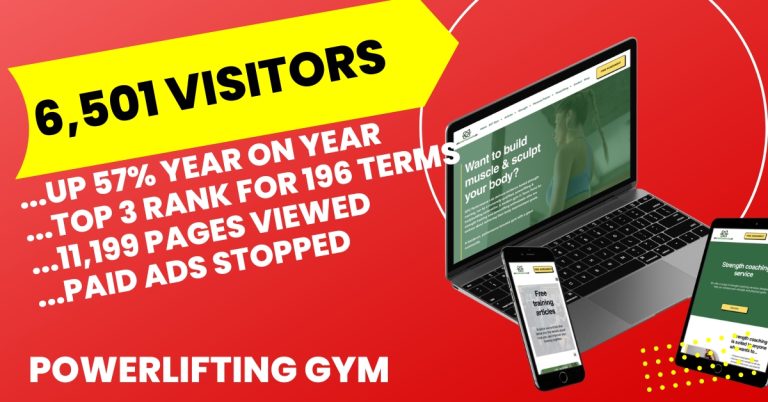
Nu-Trend and Passion Built both show real growth that plateaus once the business stopped building on the foundation. A redesign can even actively cost a business its rankings when the visual layer gets prioritised over the substance underneath it. This firm’s result sits in between those two: the rebuild didn’t hurt them, and it genuinely fixed something real, it just isn’t a substitute for the ongoing, less glamorous work the original audit actually called for.
If you’ve had an audit, a strategy document, or a list of recommendations sitting half-finished, and you’re not sure whether what’s already done is actually enough, get in touch and I’ll tell you honestly what’s working, what isn’t, and what the harder half would actually get you.
I don’t just hand over a list of recommendations and disappear. I stay accountable for making sure the whole plan gets executed, not just the parts that were easy to schedule in. If you’re sitting on advice you never fully acted on, see how I could help.