How to evaluate a media kit so your business doesn't get ripped off
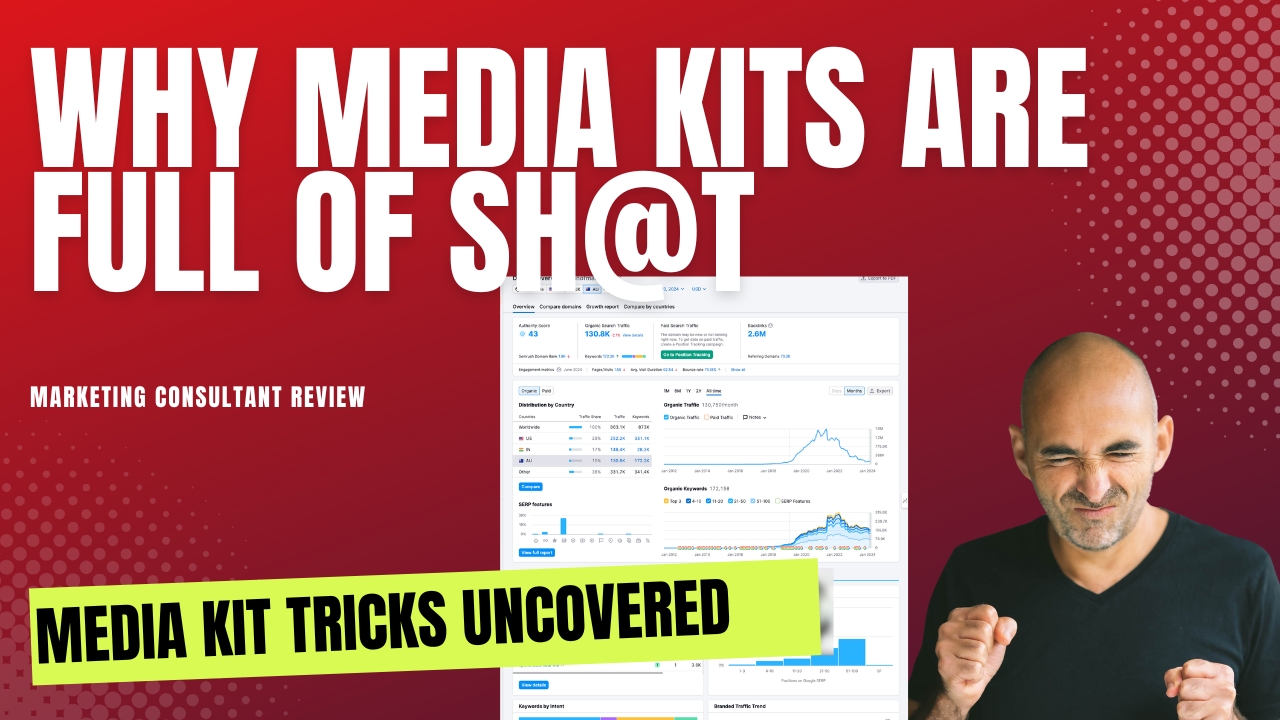
A website owner was selling advertising to Sydney businesses. Her media kit promised a local audience, strong engagement, thousands of loyal followers. Sydney businesses paid for campaigns believing they were reaching Sydney customers.
When I actually pulled the data, none of it held up. Close to 40% of the website’s traffic was coming from the United States, not Australia. A social following presented as tens of thousands of engaged fans was concentrated in countries with no connection to any of her advertisers, and the engagement on it was so low, a few hundred views on posts to an audience in the tens of thousands, that it showed every sign of being bought rather than built. The business owner selling this wasn’t lying to her advertisers on purpose. She genuinely didn’t know. Nobody had ever asked her to prove it, so she’d never had to check.
That’s the real risk with media kits. It’s not that every publisher, magazine, influencer or website is deliberately running a scam. It’s that a media kit is a sales document made by whoever benefits from you believing it, with no independent body checking a single number in it, and until an advertiser demands proof, there’s no reason for anyone to look too closely at their own numbers either.
Here’s how to make sure you’re not the advertiser who never asked.
Nobody checks a media kit but you
Anyone can put a media kit together, and plenty of free templates exist to make one look polished in an afternoon. There’s no regulator, no audit, no independent verification behind any of it. That means the trust is entirely one-directional: you’re being asked to believe a Powerpoint, when the actual numbers behind every claim in it are a few clicks away in Google Analytics, Search Console, or the platform’s own insights tools, if the publisher is willing to show you.
Most won’t be asked to.
In my experience, most account managers presenting a media kit don’t know the real numbers behind their own pitch either, because nobody has ever made them check.
What was presented

THE REALITY

What was presented

THE REALITY

Ask what the number actually means, not just how big it is
Every term in a media kit sounds impressive and means almost nothing without context.
- “Uniques” or “visitors” could be daily, weekly, monthly or annual, and could include people who’ve never heard of your business and never will. 55,000 uniques sounds strong until you learn it’s a year of global traffic to a homepage nobody stays on.
- “Impressions” usually means how often a page showed up in a Google search result, not how many people saw or clicked it. 10,000 impressions with a 1% click rate is 100 actual visits. Impressions without a click rate next to them tell you nothing.
- “Pageviews” counts visits to a page, not engagement with it. Thousands of monthly pageviews spread across 2,000 stories can mean each individual article gets seen by almost nobody, for a few seconds each.
- An “EDM” or email database is only as valuable as its open rate. I once audited a site with more than 10,000 people on their email list and under 10% actually opening it, which meant a database that looked impressive on a slide was really reaching about 1,000 people, a fraction of what was implied.
- Social media followers or “fans” mean nothing without engagement data next to them. The average Facebook page engagement rate is around 0.18%. If a publisher won’t show you likes, comments and shares per post next to their follower count, or where those followers are actually located, that’s the question they’re hoping you won’t ask.
The questions that separate a real number from a marketing number
If a media kit makes a claim, it’s fair and reasonable to ask for the data behind it before you spend a dollar. These are the questions I’d ask on your behalf:
- What percentage of your visitors, readers or subscribers are actually in Australia (or wherever your customers are)?
- What percentage of your social media audience is in the same location?
- What’s the average reach and engagement of a single social media post, not the follower count?
- For email, what’s the actual open rate and click rate, not the list size?
- What’s the average time people spend on an article, and how many actually finish reading it?
- Of the brand names shown as “partners,” how many were repeat bookings versus a single one-off placement?
If those answers aren’t forthcoming quickly, or you get pushback for asking, that tells you everything you need to know about whether the numbers would hold up.
Big claims deserve extra scrutiny, not less
Watch for the specific tactics that show up again and again in media kits:
- Vague superlatives.“Biggest homepage in the country” sounds impressive and means nothing if most of your customers are on mobile. Being the biggest doesn’t guarantee placement, engagement, or that anyone can even find the page.
- Time-on-page claims with no benchmark. “27 minutes per person” sounds extraordinary for a website, because it almost certainly is. Ask what that’s measuring, and against what average, before you believe it.
- Circulation dressed up as readership. Print media increasingly quotes “readership” (an estimate assuming multiple people read each physical copy) rather than actual circulation, because circulation numbers have been declining for years. A website can tell you exactly how many people viewed exactly which page. A magazine estimating that 2 or 3 people read each printed copy cannot.

- Discounted “value.” If a special rate is being offered at 50% off some stated value, ask how that value was calculated in the first place. Usually, it wasn’t, it’s a number invented to make the discount feel bigger than the actual price being charged.

- Reach through “amplification.” Claims about reaching audiences across a network of partner sites often collapse from “millions” to a few thousand once you ask which specific sites, which specific placements, and what the real numbers are for each.


What proof of performance actually looks like

Before you commit budget, agree upfront on how the publisher will prove the campaign worked, not just how they’ll pitch it beforehand.
For a paid article or review, a legitimate publisher can show you exactly how much traffic that specific piece generated, where those readers came from, how long they stayed, and whether they clicked through to your site. You can verify independently on your end too: check your own Analytics for a visitor spike when the piece went live, and Search Console for any movement in your own keyword rankings.
If a publisher can’t or won’t provide page-level performance data for the specific placement you paid for, that’s not a technical limitation, in 2026 the tools to measure it are free and standard. It’s a choice.
What a media kit is, in plain terms
A media kit is a promotional document, made in-house by whoever is selling the advertising space, with no independent verification behind any of it. It exists to convince you to spend money, not to give you an objective account of the audience. That doesn’t make every media kit dishonest, but it does mean the burden of verification sits with you, the advertiser, not with the publisher presenting it.
If you’d rather have someone else pull the real numbers apart before you commit a marketing budget, get in touch and I’ll audit the proposal and the platform’s actual data on your behalf. I’ve pulled apart enough media kits to know the gap between what’s presented and what the real data shows can be significant, and the business owner selling it often doesn’t know either. If you’ve been pitched a media proposal and want a straight answer on whether the numbers hold up,