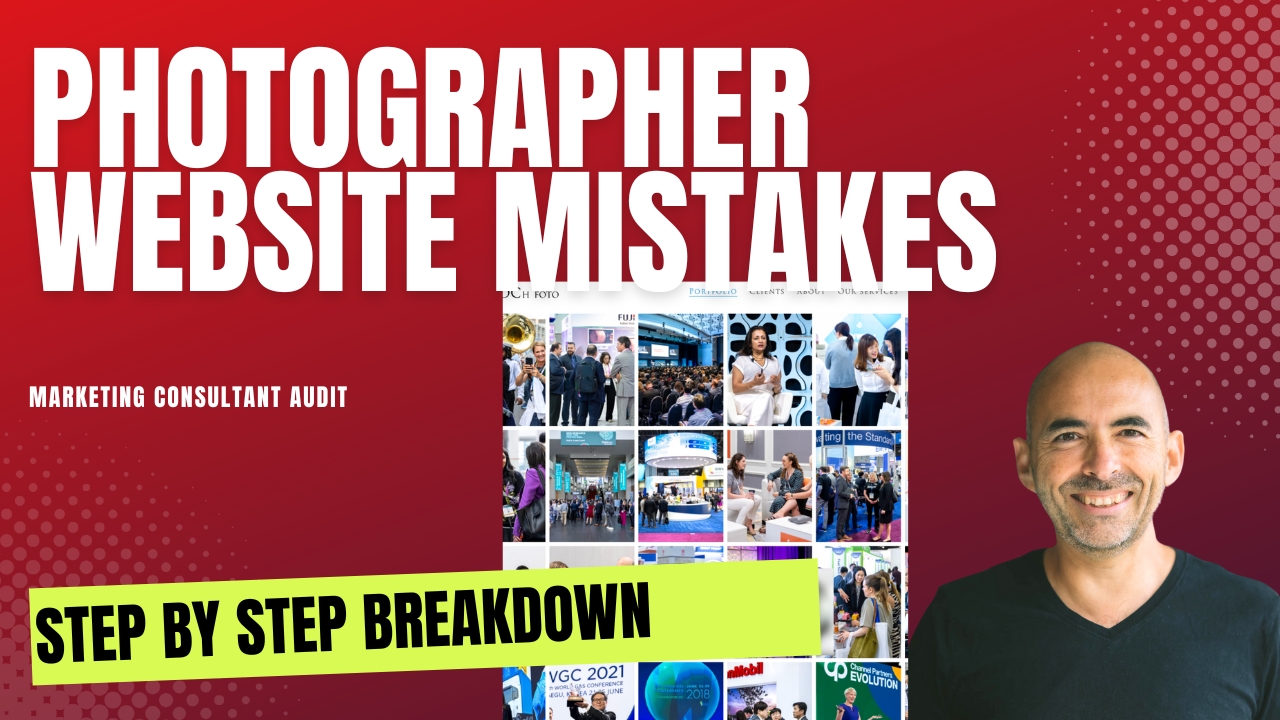
Live review: why a photographer wasn't getting any leads from his website
A husband and wife team running a corporate event photography business reached out to me through my website. More than 20 years in business, based in one US state but wanting to win work nationally, priced higher than most competitors because their packages included post-production, usage rights and high-resolution files most others charge extra for.
Their problem: enquiries had dropped to almost nothing.
They’d tried a marketing agency, tried running their own Google Ads, and neither had worked.
I reviewed it the way I review every photographer’s site that comes to me, partly as a marketing consultant, and partly because I ran my own photography business myself for several years after leaving full-time employment in 2016.
I know what it’s like to be on the other side of this exact problem.
What a search for their own name turned up
Searching their business name directly didn’t return a clean result, several similarly named businesses came up alongside them, which is its own quiet problem: a potential client typing your name shouldn’t have to guess which result is actually you. There was no Google Business Profile at all, which meant no reviews, no local search visibility, and no easy way for anyone to confirm the business was legitimate before enquiring.
Their LinkedIn presence existed but wasn’t doing much: beautiful photos with no context, nothing explaining who the images were for or how they’d been used, and no personal profile for either owner, no photo, no bio, nothing that helps a client picture who’d actually be behind the camera at their event. For a business built on a personal, trust-based service, that’s a real gap.
The website itself was working against them
- The homepage was slow to load and immediately redirected to a single portfolio gallery that read like photos from one event, not a showcase of range.
- Several images repeated.
- There were no product shots, no booth photography, no headshot examples, despite all of those being services they actually offered.
- Body text throughout the site was set in blocks of capital letters, genuinely harder to read, and company logos they’d worked with were listed as plain text rather than displayed as logos, forcing a visitor to read through a wall of capitalised names just to see who they’d worked with.
- There was no H1 heading anywhere on their main service page, the single most basic on-page SEO element a site can have.
- On mobile, a gallery with that many images became something close to unusable.
- A quick check in SEMrush showed no meaningful organic traffic going back to 2012.
What real competitors were doing differently
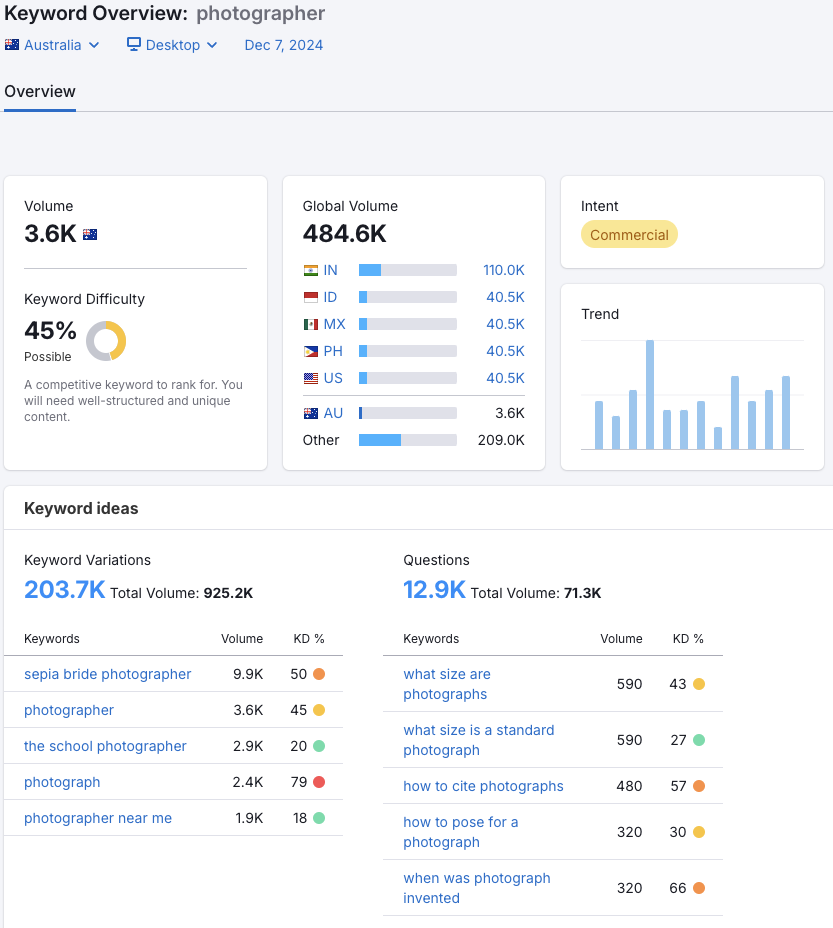
I searched the same terms a real customer would use and looked at who actually showed up. The businesses ranking well shared a pattern: fast-loading pages, a clear logo and service description within seconds, genuine variety in their photo examples rather than one event’s worth of shots, visible reviews, and clear service pages that didn’t require reading a wall of text to understand what was on offer. One competitor had structured location-specific pages for different cities, another had inconsistent execution but still out-ranked this business purely on the strength of having far more relevant content.
Ads occupied the first four positions before any organic result even appeared, for a genuinely competitive search with hundreds of millions of loosely related results. Running paid ads on top of a website like this one wouldn’t have fixed anything. Poor conversion on the landing page just makes every paid click more expensive for the same result.
Proof the alternative actually works: my own numbers
This isn’t theoretical advice.
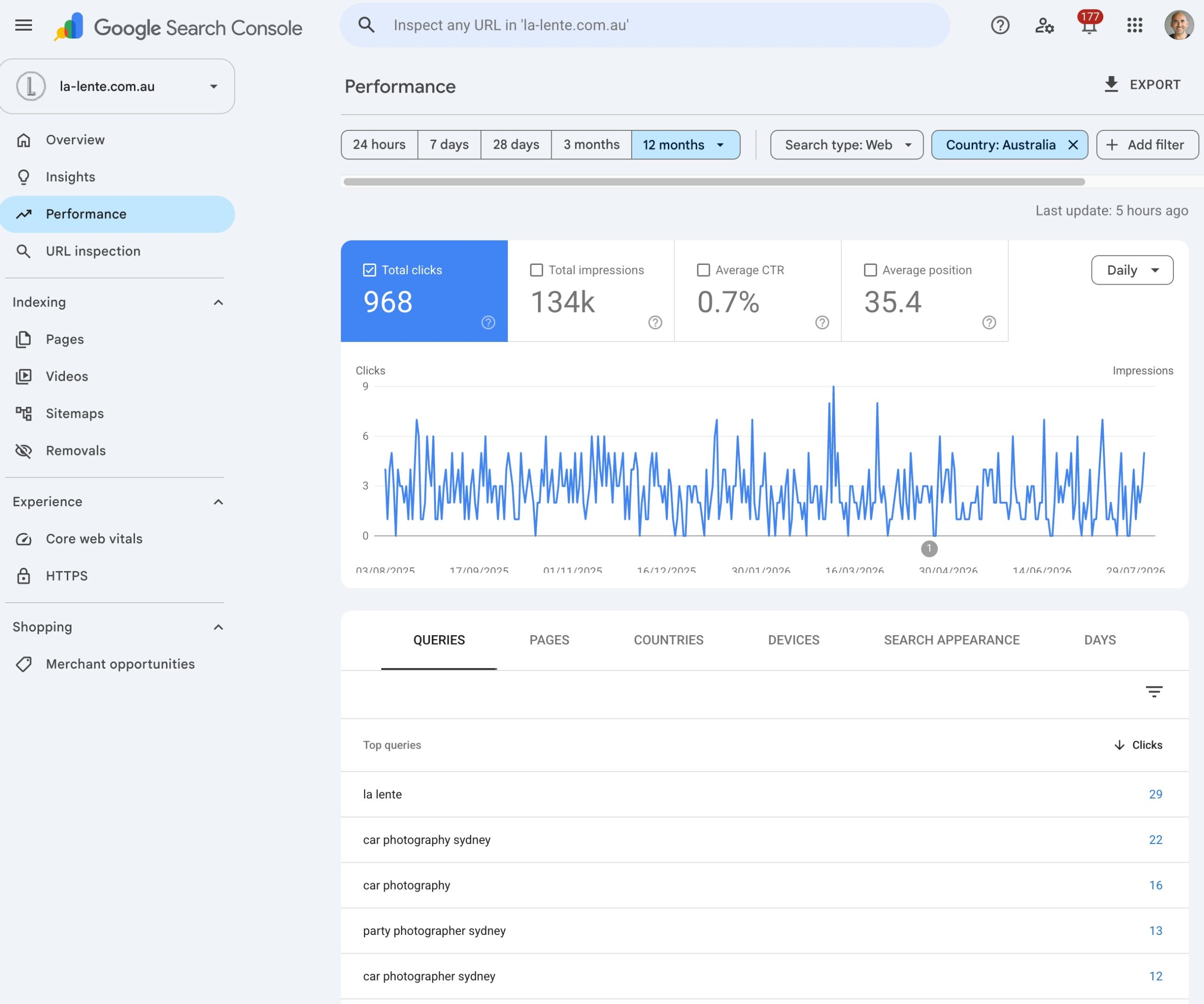
My own photography site La Lente in the past has ranked for specific, niche services like “Baptism photographer” rather than trying to compete as a generic “photographer” and I can show exactly what that produces, because it’s my own Google Search Console data. Getting found for specific services helped me secure bookings every weekend for various types of events that needed a photographer.
: in the last 12 months even though the website hasn’t been updated for a few years & there have been so many changes to Google’s Algorithm the site has still managed to get close to 1,000 clicks from search from Australians mainly for car and party related phrases with the average position between 2 and 5.
Looking back, I never spent a cent on advertising for that business. Every enquiry came from search or referrals as the website was built entirely on individual service pages, real examples matched to each niche and a strong Google Business Profile with over 100 reviews.
That’s the exact strategy this photography business needed and didn’t have: individual pages for each specific service (corporate events, headshots, product photography), each with its own examples, rather than one generic site trying to speak to everyone at once.
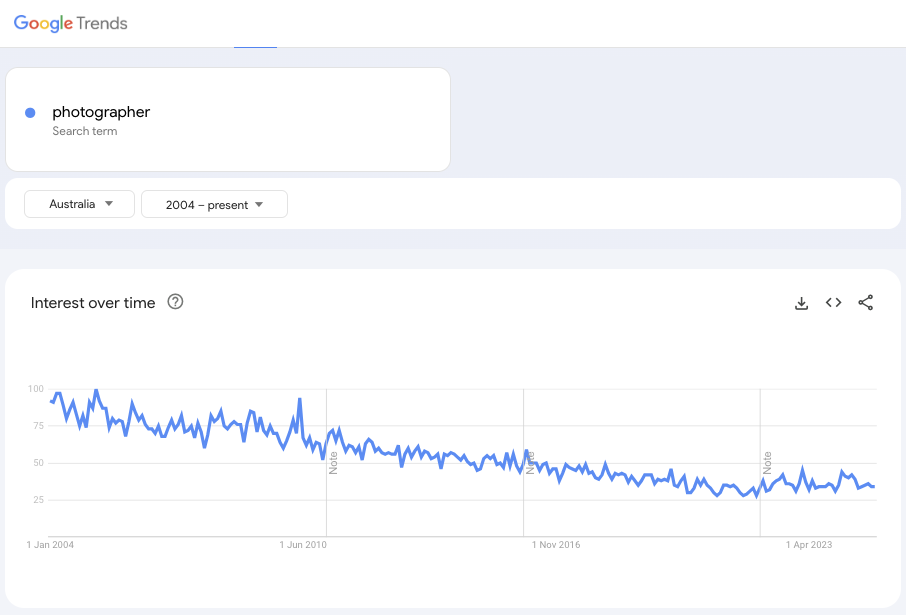
Even considering the reported decline in search demand for a photographer since 2004 (Source Google Trends) people still want and need one even if the volume of work has declined due to people using their smartphone.
To their credit, they'd already been given good advice
They’d received a proposal from another marketing agency before contacting me, and it was genuinely solid: rebuild the website, implement SEO, improve social media, build a proper sales funnel, back it with real keyword research (including specific search volume for corporate event photography in a target city they wanted to expand into).
I wouldn’t have structured it much differently myself.
They didn’t proceed, not because the advice was wrong, but because they weren’t willing to spend the $5,000 for a rebuild or the ongoing $1,200 a month for SEO and content.
That’s a real, fair business decision to make. It just means the underlying problem stays exactly where it was and they didn’t take any other actions to change things.
What actually needed to happen
- Rebuild the website with individual pages for each specific service, not one generic site
- Fix the fundamentals: proper heading structure, faster load time, a workable mobile experience
- Show genuine variety in photo examples, matched to each specific service
- Set up a Google Business Profile and start collecting reviews from past clients
- Create content around specific niches and locations they wanted to win work in
- Hold off on any paid advertising until the site could actually convert a visitor into an enquiry
None of this required inventing a new strategy. It required the same approach that’s earning my own photography site regular, unpaid enquiries: specific pages, for specific services, backed by real examples and real local visibility, instead of one generic site hoping to be found for everything at once.
If your own site has been sitting unchanged for years and leads have quietly dried up, get in touch and I’ll review it the same way. I’ve run my own service business on exactly the strategy I recommend to clients, individual pages, real examples, genuine local visibility, so I know it works because I can see it in my own Search Console data, not just a client’s. If your website isn’t generating the leads it should be, see how I could help.