
Why keeping the same team to do your marketing guarantees the same results
A business owner genuinely wants to grow. She commissions a real, thorough audit, forty-plus pages of it, real data, real specifics, a genuinely clear picture of what’s wrong and what to do about it. Then, when it comes to actually fixing it, she keeps the exact same team that couldn’t get it right the first time, because bringing in the right help feels like a cost she isn’t sure she can justify yet. Nothing changes. Which, if you think about it for a second, was never actually in doubt.
That’s not a hypothetical. It’s a real audit I carried out in 2020 for an established health and wellness content business, real books published, real speaking engagements, a real and genuinely engaged audience. I’m not naming the business, because what’s useful here isn’t who it was, it’s the pattern, and the pattern is common enough that you’ve probably seen a version of it in your own business.
What the audit actually found
The technical depth here was substantial:
- A mobile PageSpeed Insights score of 9 out of 100
- Over 1,000 pages flagged with redirect issues or crawl anomalies
- Live, public buttons on the homepage still pointing to the staging domain from a website migration that was never properly cleaned up
- Recipe pages with no schema markup at all, despite schema being exactly what helps recipe content get featured in search
- No Google Business Profile, despite the brand’s core products including in-person consultations and speaking
- An average search position that had been declining for 16 straight months
- Keyword breadth that had fallen from over 1,100 ranking terms at its peak to a fraction of that
The gaps between visibility and actual traffic were stark.
Search terms related to “Fats” earned over 2,500 impressions with a 0% click-through rate. Every query containing the word “how”, meaning someone actively looking for an answer, had earned 1,230 impressions and not a single click. Terms directly tied to the business’s own corporate offering brought in 4,300 impressions and zero clicks.
The business’s single hero product had earned exactly 5 clicks in 12 months for the exact phrase describing it.
None of this was a business with no audience. The brand had genuine authority, over 600 real backlinks, a first-page result for its own name, real recognition. The problem sat entirely in execution: broken technical foundations quietly capping what all that real authority should have been earning.
The part that actually matters: she knew
This is what makes the pattern worth writing about, rather than just another audit story. The owner wasn’t confused about her business. In writing, she laid out her actual revenue priorities clearly and specifically: speaking engagements first, consultations second, her flagship paid program third, books fourth. She knew exactly what she wanted the website to sell harder. She asked sharp, reasonable questions about cost and duplication of effort before committing to anything further.
She also knew, at some level, that her existing team wasn’t equipped for what needed to happen next. In one exchange, a staff member had told her a specific technical fix “couldn’t be done.” It took me a matter of minutes to prove that wrong. A separate technical issue, missed entirely by the contractor managing her hosting and IT, had to be caught and fixed by someone else checking behind him. These weren’t one-off slips. They were a pattern she’d already started to notice herself.
The catch-22
Here’s the actual trap, stated plainly: proper execution needed either more time from people who understood the technical requirements, or a different, more capable resource entirely. Both cost more than what was already being spent. Justifying that spend felt like a risk. So the default became keeping the same people, at the same limited hours, doing the same kind of work that had already produced the site the audit had just spent forty pages documenting.
That’s a self-fulfilling outcome by design, not bad luck. If the inputs don’t change, meaningfully, the output doesn’t either. Hoping the same team will produce a different result on the second attempt, having already shown they couldn’t on the first, isn’t a strategy. It’s the absence of one, dressed up as caution.
Why this isn't really about money
To be clear, hesitating over a real cost is completely reasonable. The catch here isn’t that she should have spent without question. It’s that the actual choice in front of her, keep spending a smaller amount on an approach already proven not to work, or invest properly in the thing the audit showed was actually needed, never got made as a real decision. It just defaulted, quietly, to the cheaper, familiar option, and stayed there. A year on, by the correspondence available, the same technical issues were still being reported by Google, months after they’d first been raised.
This is the same underlying shape as why business owners only execute half their marketing advice, just a step earlier in the process. That piece is about the advice that does get partially acted on. This one is about advice that never gets resourced enough to be acted on at all, because the resourcing decision itself kept getting deferred.
What the data shows years later
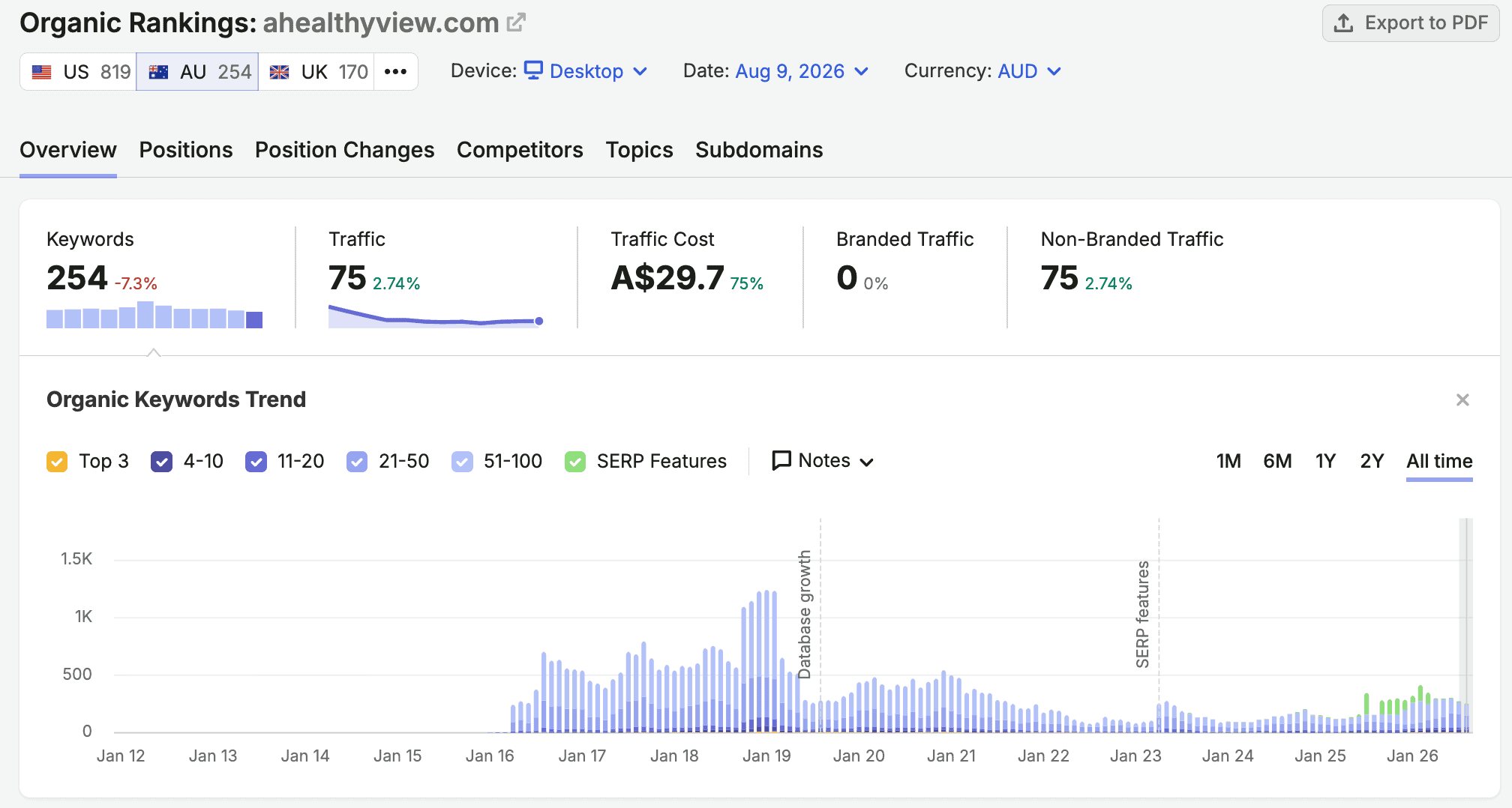
Worth being upfront about the source here: this next part comes from a third-party tool (SEMrush), not the business’s own Analytics or Search Console. That’s an estimate, not a certainty, the original audit itself made the same distinction at the time. But the scale of what it shows is hard to explain away as a tool quirk.
- Years later, the site’s Australian organic search traffic has kept declining, down another 7% year on year, even as its backlink profile has actually grown substantially in the same period albeit from somewhat unusual links. That combination on its own tells a story: the brand’s authority kept building in the background, while the technical and content execution needed to actually convert that authority into search visibility never got fixed.
- AI search visibility for Australia specifically sits at effectively zero across every major AI tool checked, not a small gap for a business trying to be found today.
- The clearest single data point is this: close to 60% of all the site’s current Australian organic traffic comes from two search terms asking whether a well-known fast food chain is healthy. That’s not a typo, and it’s not a one-off. It’s the single largest source of visibility the business has left, and it has nothing whatsoever to do with corporate speaking, consultations, the flagship program, or the books, the four things the owner herself named as her actual revenue priorities.
- Here’s what makes this genuinely remarkable rather than just an odd fact: the original 2020 audit already identified this exact content, by name, as a problem. It noted the page performed well for search but had a 95.6% bounce rate, and asked directly whether it was worth pursuing “given it isn’t keeping people on the site or driving them to explore other ideas or topics.” That was the call to action six years ago: stop chasing tangential curiosity content, and build out the pages that actually reflect the business’s real priorities instead. Neither happened. The same piece of content the audit warned about is now carrying the majority of what little search visibility remains.
That’s not new bad luck. It’s the same indecision, still unresolved, years on.
The site never got the investment the original audit called for, so it kept doing exactly what it was already doing, and search rewarded exactly what it was already producing: not the business’s real priorities, but whatever tangential content happened to catch a wave of curiosity. Nothing about the underlying pattern changed. It just had years to compound.
If you’ve had a real audit or a real set of recommendations sitting there, and the honest reason nothing’s changed is that the team executing it is the same team that couldn’t get it right before, get in touch and let’s talk about what it would actually take. I’ll tell a client plainly when the real blocker isn’t strategy, it’s resourcing, because no amount of good advice fixes a technical gap the people executing it aren’t equipped to close. If you suspect that’s what’s happening in your own business, see how I could help.