
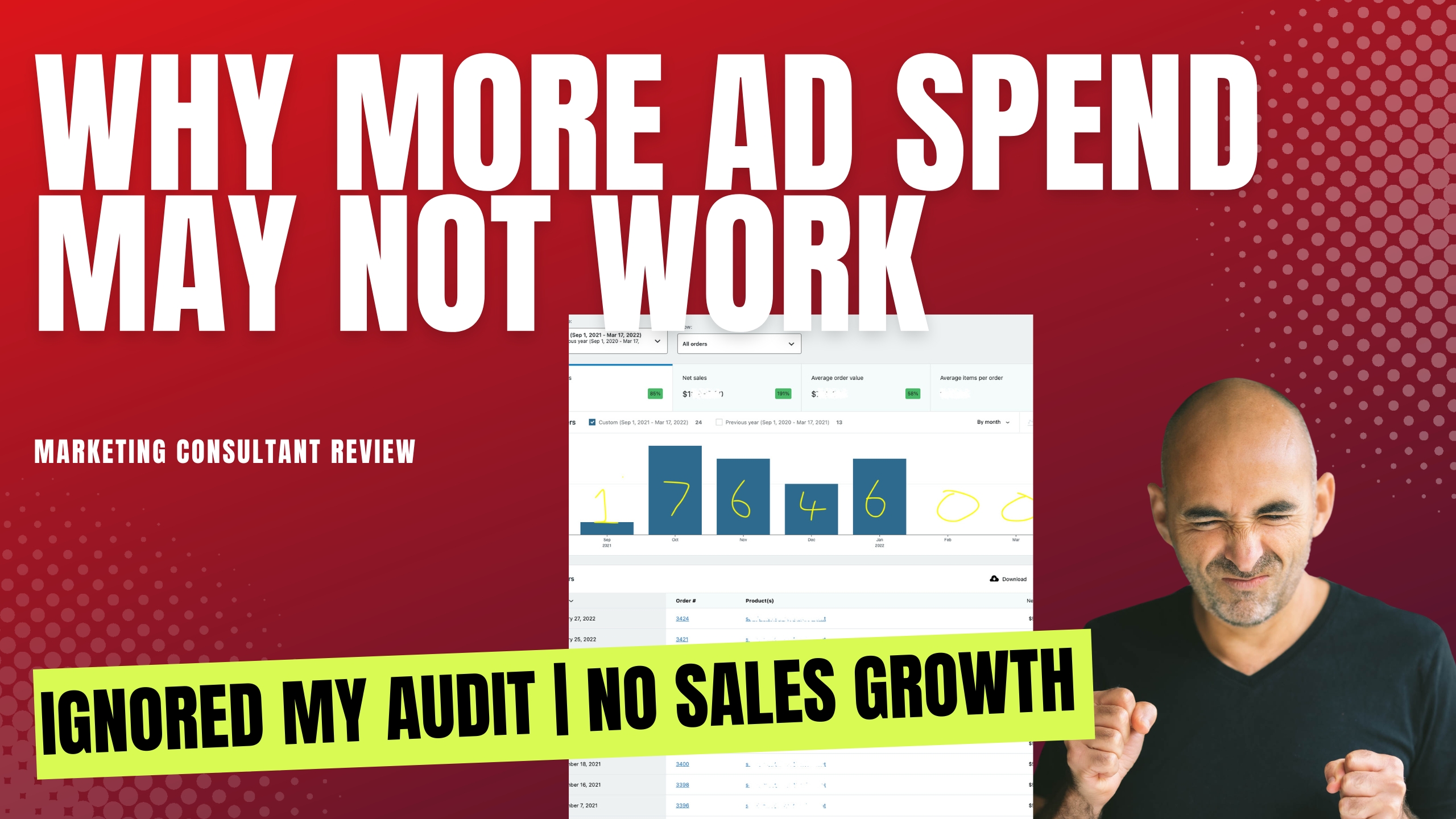
Spending more money on ads won't automatically increase sales
- This brand didn’t want to change many of the fundamental issues I highlighted in my digital audit & their sales performance remained poor.
- Sales across the January to February period fell from roughly $24,000 in 2022 to roughly $5,000 in 2023, a decline of about 79% in the year following the audit
- In the four months after the audit was delivered the business sold seven units in total, an average of fewer than two a month at $585 each
- The implementation programme they declined was costed at roughly $11,500 across a website update and six months of ongoing work, against a Google Ads account that had already absorbed more than $8,000
- Visitors arriving from those ads converted at 0.45% while referral traffic to the same site converted at 10.77%
- The feature the entire brand had been built around accounted for 140 of the 38,860 monthly category searches I measured in Australia so they weren’t even getting found for the problem their product solved.
- Six months later the site had been visually refreshed, every structural problem I had documented was still in place, and no second audit was ever requested to see if anything had improved.
The marketing brief they gave me, in their own words
In October 2021 the leadership team of a business selling wearable medical alert devices to older Australians told me that their paid advertising and social media activity had not delivered the results they wanted, and that they were looking to explore other digital marketing strategies.
That is the brief almost verbatim and it contains a diagnosis that nobody had tested.
The assumption inside the sentence is that the advertising is the part that is broken and that a different channel might work better, when the actual question is whether anything any source of traffic generated was capable of converting a visitor into a customer regardless of which channel that visitor came from.
At first I wasn’t surprised because from experience a lot of brands do spend lots on advertising without the right execution to get results. Paid Ads on Google or Meta can be the quickest or simplest thing to blame as they are very visible but the issues can be in other areas entirely.
The only way to prove this is to measure and test it correctly which they weren’t doing. What I proposed instead was a sequence that started with competitor analysis, then keyword and topic research, then a review of the website’s structure and technical setup, and only after those three pieces of work were complete would anybody be able to decide what to change.
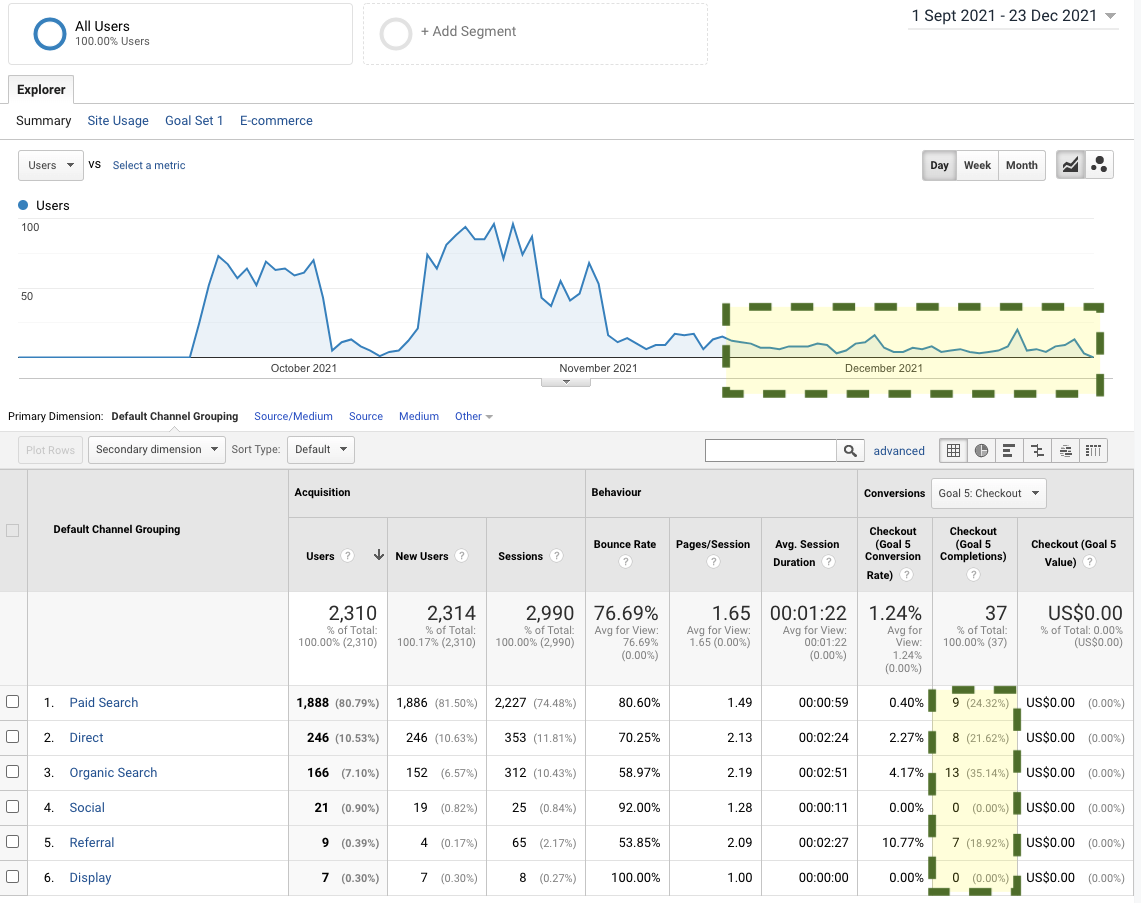
They agreed to the diagnostic work, and I delivered one of my digital marketing audiits in February 2022 which I will cover in more detail in the rest of this article, but as you can see below, none of their channels were converting at a high % with any real volume.
The structured method i proposed before the audit was done
My proposal committed in writing to focussing on three pillars, which were;
1. Getting discovered – so growing visibility using different mediums.
2. Making people believe – present engaging content to build trust & credibility.
3. Turning them into customers – converting visitors into buyers.
Every one of my recommendations in the finished audit sat under one of those three headings. That sequence was decided before I had gathered a single number about this particular business.
If the framework is chosen after the data arrives, then what you produce is a reaction and a reaction tends to fixate on whatever the main issues that were discovered.
If the framework is chosen first, then the data either fills it in or it does not, and the findings end up in proportion to the problem rather than in proportion to how strongly anybody feels about it. That is the difference between an assessment and an opinion.
It is the whole reason a business would bring in someone who has no history with any of the decisions being examined because it is diagnosing exactly what the issues or gaps are in the marketing strategy.
Why marketing advice should have no loyalty to your brand
As an external marketing consultant I carry no loyalty to the name, the logo, the brand, the pricing model or the feature the business had decided was its point of difference. Therefore my focus is purely on what actions should be taken to improve business results, why & how.
Everybody inside the business does carry that loyalty and with that there is an emotional connection to all the decisions they made and why they feel what they have done is great. That attachment is completely normal but also completely useless when trying to diagnosis issues & improve them.
I have written before about the way business owners execute only half the advice they receive, which occurs when business owners don’t want to accept critical feedback, don’t have the team to deliver what is required or are too fearful the changes suggested will work.
My audit uncovered a huge gap in understanding
The most significant thing my audit uncovered was that consumers may not have wanted what they were selling.
This business had built its brand, its pricing structure and its entire competitive argument around the fact that its device came with professional monitoring. They had made a reasonable assumption that monitoring was what separated it from the cheaper devices in the category & thus a unique differentiator.
Although the data showed there was little interest for that.
When I grouped every relevant search term and totalled the volumes, the assumption didn’t make a lot of sense when I looked at Australian search volumes.
Monitoring was less than 1% of relevant search volume as you can see in the chart.
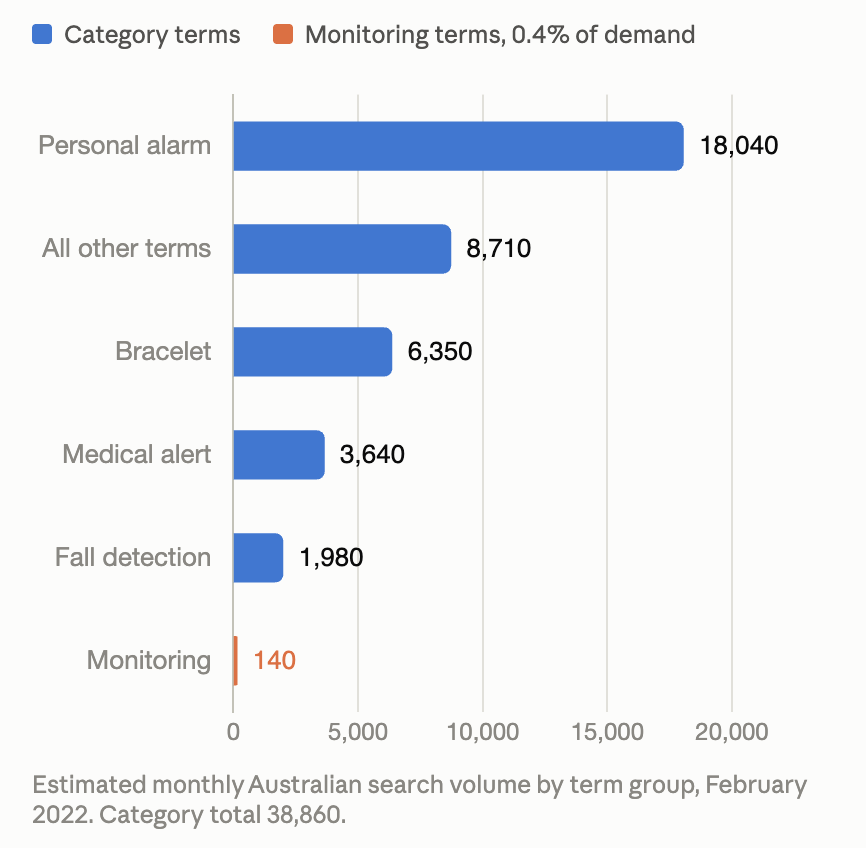
That finding does not prove monitoring has no value and I was careful to say so in the audit itself, because there are three explanations that fit the same data equally well.
- Consumers may genuinely not want a monitored service and may be satisfied with an alert reaching a family member’s phone.
- Consumers may not know that monitoring exists as an option, in which case this is an awareness problem rather than a demand problem. Unusually I couldn’t even find ‘what is monitoring’ type of phrases.
- Consumers may assume that a safety device of this kind is monitored as standard and therefore never think to search for the word. Although in my experience there would still be people researching for ‘best monitoring’ type of phrases or reviews of monitoring services etc.
Which of those three is true is a question that a customer research survey can settles in a fortnight and a keyword tool may never settle completely, and my recommendation was to go and find out rather than continue building on an assumption that had never been tested.
What was not in doubt is that the brand was leading with a benefit almost nobody was typing into a search box, while ranking for none of the terms the rest of the category was competing over.
So leading with a differentiator that customers do not search for can be a legitimate strategy, but it has to be a deliberate one, and the business then has to create the demand rather than assume it is already sitting there. In this case they were not doing that & didn’t even have content on their site to help people learn about its capabilities.
Two brands, six names selling one device
The parent business had created this second brand specifically to sell direct to consumers online, keeping the original brand for its traditional in-home demonstration and traditional print advertising model.
From the inside that separation is coherent, because it splits two genuinely different routes to market. From the outside, somebody researching a purchase ran into the original company name, the shortened version of that name used in its web address, the trademarked product name, the new brand name, a longer version of the new brand name used in the logo, and a different word again in the new brand’s web address.
Six identities, two websites, one device, and one marketing budget divided between them.
The new brand name also collided with an unrelated ambulance service, an unrelated clinical software product and an unrelated healthcare staffing agency, all of which appeared in the search results for it, which meant the business was fighting for attention on its own name before it had begun fighting for anything else.
The trademarked product name, meanwhile, was unique, ownable and already carried a recognised international design award, and it was the one asset nobody had chosen to build a brand around.
The justification for the split rested entirely on the path to purchase and the method of payment and consumers do not care about either of those until after they have decided they want the product. So in a very crowded market it didn’t make a lot of sense strategically to pursue this go to market strategy, especially when the design award was essentially a secret not being promoted.
Where the money was going
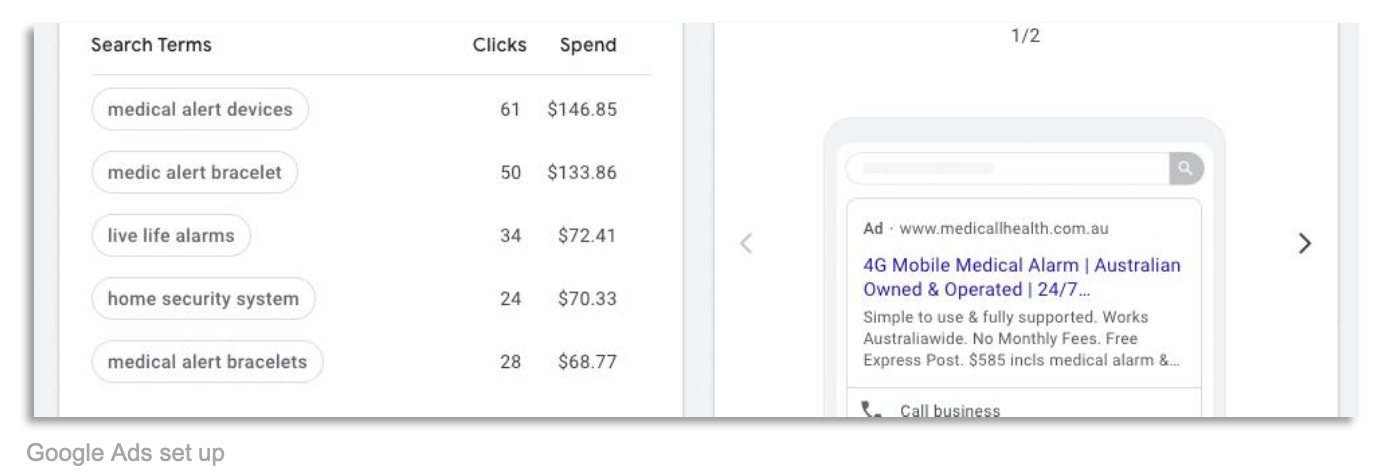
The Google Ads account had been set up in the simplified mode rather than the full version, which removes a lot of manual controls that make a campaign improvable over time, and more than $8,000 had been spent this way already. By doing this you are trusting Google with your money and yet they are the company running the ads.
It was full of issues;
- The geographic targeting was set to a single territory rather than nationally, which for a product sold to seniors across the whole country is a silly thing to get wrong.
- The keyword list included a direct competitor’s brand name, which can be an effective strategy but only when the ad and the landing page make an explicit comparison argument, and neither of them did, so anybody arriving from that search found a different brand talking about itself and left immediately.
- The list also included home security terms with no connection to the product whatsoever. The behaviour of visitors from those particular searches was unambiguous, with bounce rates close to 100% and time on site recorded at one second in several cases, which is what it looks like when somebody realises instantly that they are in the wrong place so it was wasted money.
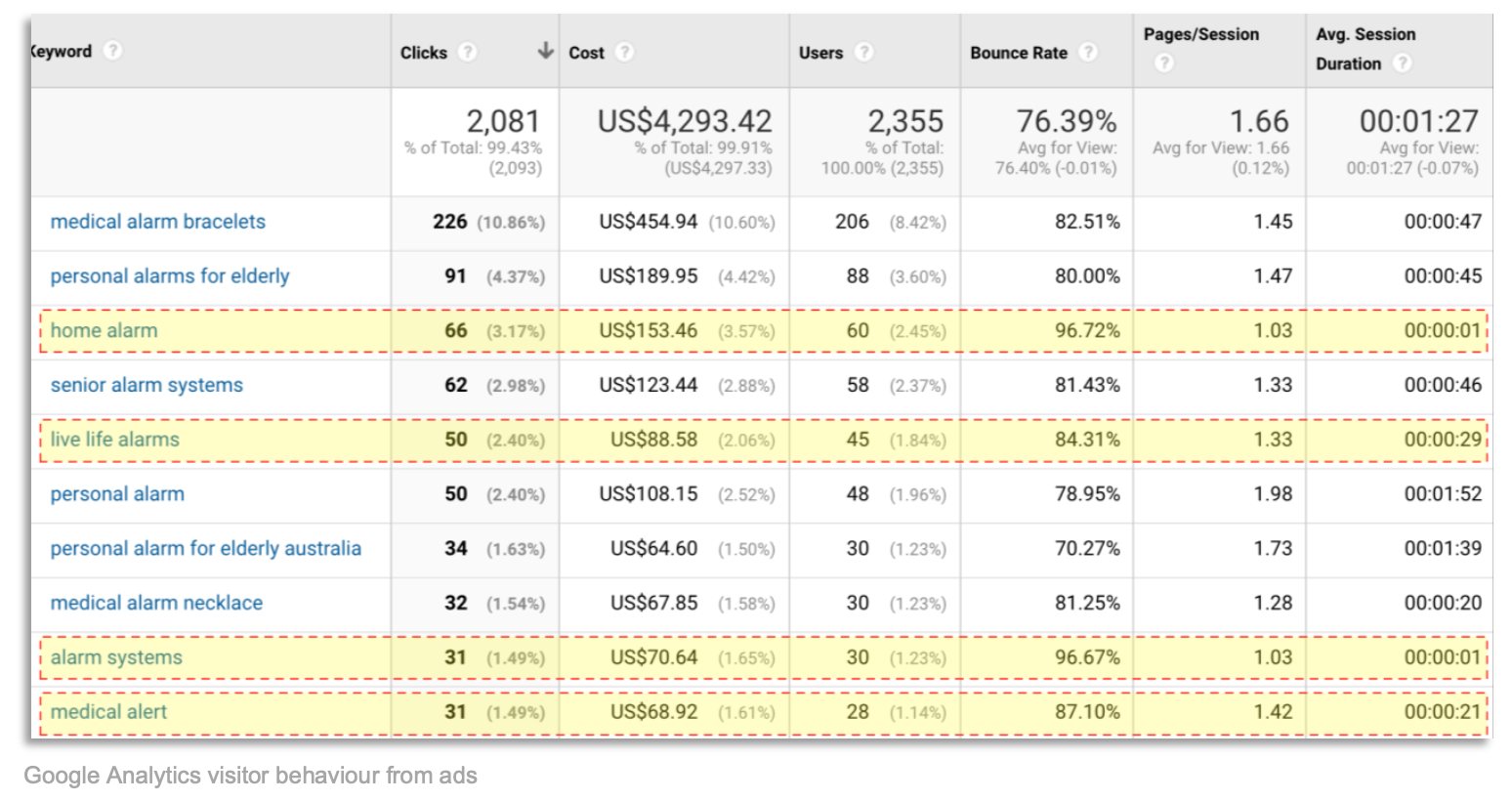
Comparing paid ads to other sources;
- Paid Ads – 1,888 people arrived from paid search and converted at just 0.45%.
- Referral traffic to the same site over the same period converted at 10.77%
- Organic search converted at 3.62%.
So the source that cost the most money performed worst by a factor of more than twenty against the best performing one, and that comparison should have prompted a conversation months before I was involved.
The point I made in my audit is that while they were spending thousands on paid ads that didn’t work, the majority of people were clicking on organic search results (the channel that converted best for them) and yet they weren’t developing their SEO at all.
A GroupM and Nielsen study circulating in 2022 reported that around 94% of total search engine clicks went to organic results and only 6% to paid ads, a figure quoted heavily in the industry that year.
Even WordStream’s analysis of the same study pointed out that click share across all searches is a different measurement from click share on searches with high commercial intent, where their own earlier research found sponsored results taking a far larger share.
Both things can be true at once and for this business both were relevant, because it was paying for the small commercial-intent slice while capturing almost none of the far larger research and comparison traffic that sits above it in the buying process. Source: WordStream, December 2022.
The site was terrible to use on mobile devices & losing visitors
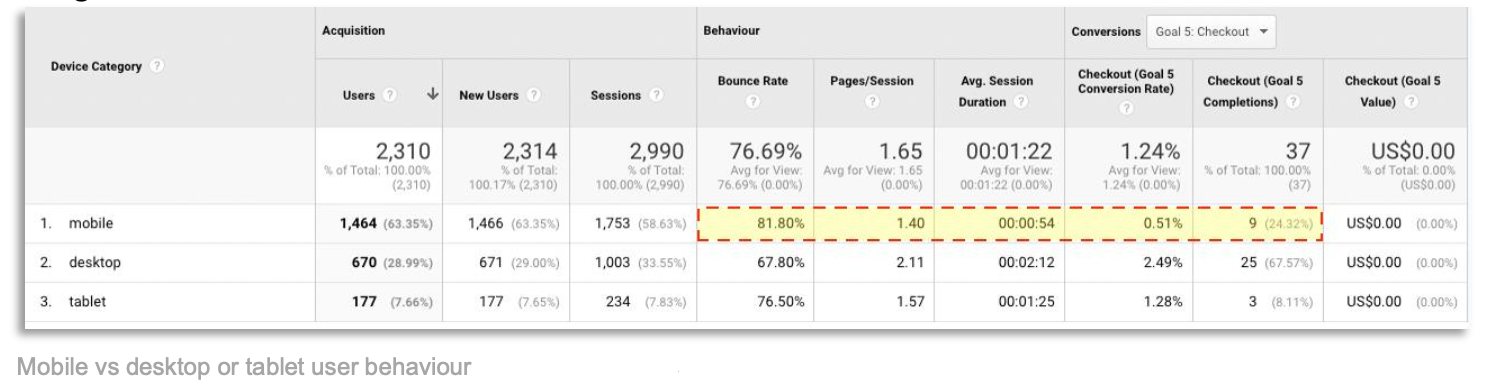
- 63% of visitors arrived on a mobile phone.
- They bounced at 81.8% against 67.8% on desktop – meaning most people left nearly immediately.
- They spent roughly half as long on the site, and converted at 0.51% against 2.49% on desktop.
What was even more telling is that the site passed Google’s automated mobile test so it could be assumed it was ok and the mobile experience is fine. It is not evidence of that at all.
The automated test asks whether a machine can render a page on a small screen, while the behaviour data that comes from looking at how humans interact with a page or pages answers a completely different question, which is whether a human found the experience pleasant enough to complete a purchase.
It wasn’t and the data was black and white.
Nearly two thirds of the advertising budget was therefore being spent to deliver people onto the version of the site that converted at a fifth of the rate of the other version.
From an ad campaign that included phrases or words not even relevant to the product being sold
Nobody could find any evidence the business was real
In a category where the product is usually bought by an adult child for an ageing parent, credibility carries more weight than copy does.
When I went looking for independent evidence about this brand I could not find any.
No Google Business Profile surfaced for the name, there were no reviews on any third party platform, the new brand had no social presence of its own and the customer stories on the site read as constructed or fabricated to fill a template rather than collected from real people with stock photography attached to them.
The competitors I analysed had hundreds of published reviews, video testimonials from named customers, and real photography of real people using the product.
The product photography told the same story.
The devices in this category look almost identical to one another, which pushes the entire purchase decision onto presentation, evidence and trust, and this site was presenting a device that had visibly been dropped onto stock images of models. Set beside the competitor sites, the difference in perceived legitimacy was obvious within seconds of landing, which is roughly how long a visitor takes to form that judgement.
The link profile said it again from another angle, with four referring domains in total, one of which was the website developer. The identified competitors had thousands. Backlinks are not a traffic source for a business of this size and I do not treat them as one, but as an indication of whether anybody in the wider world has ever had cause to mention you, four domains is close to silence.
The measurement & optimisation layers had never been built
- Google Search Console had not been set up at all and the developers did not know how to implement it, so I did it during the audit.
- No sitemap had ever been submitted, twenty one pages had been crawled and left unindexed, and fifty five URLs were excluded from the index for one reason or another.
- Ecommerce conversion tracking was not enabled in the analytics account of a business whose entire purpose was selling a product online.
- Demographic reporting was switched off in Google Analytics.
- The search query connection was not in place in Google Analytics.
- Forty three pages carried no meta description on the website which is uself for optimising search clicks.
- No SEO plugin was installed
- Heading levels across the site were being used to control font sizes rather than to describe the structure of a page.
None of that sells anything by itself and none of it is interesting to look at visually, but it is the structure needed to have any chance of getting found organically but also make the right decisions about your digital marketing to ensure it is working.
This is the same underlying confusion I described when writing about why a developer alone cannot fix an SEO problem, because building a website, getting found on organic search and making sensible business decisions using data from your digital marketing are different skills.
What the audit actually told them
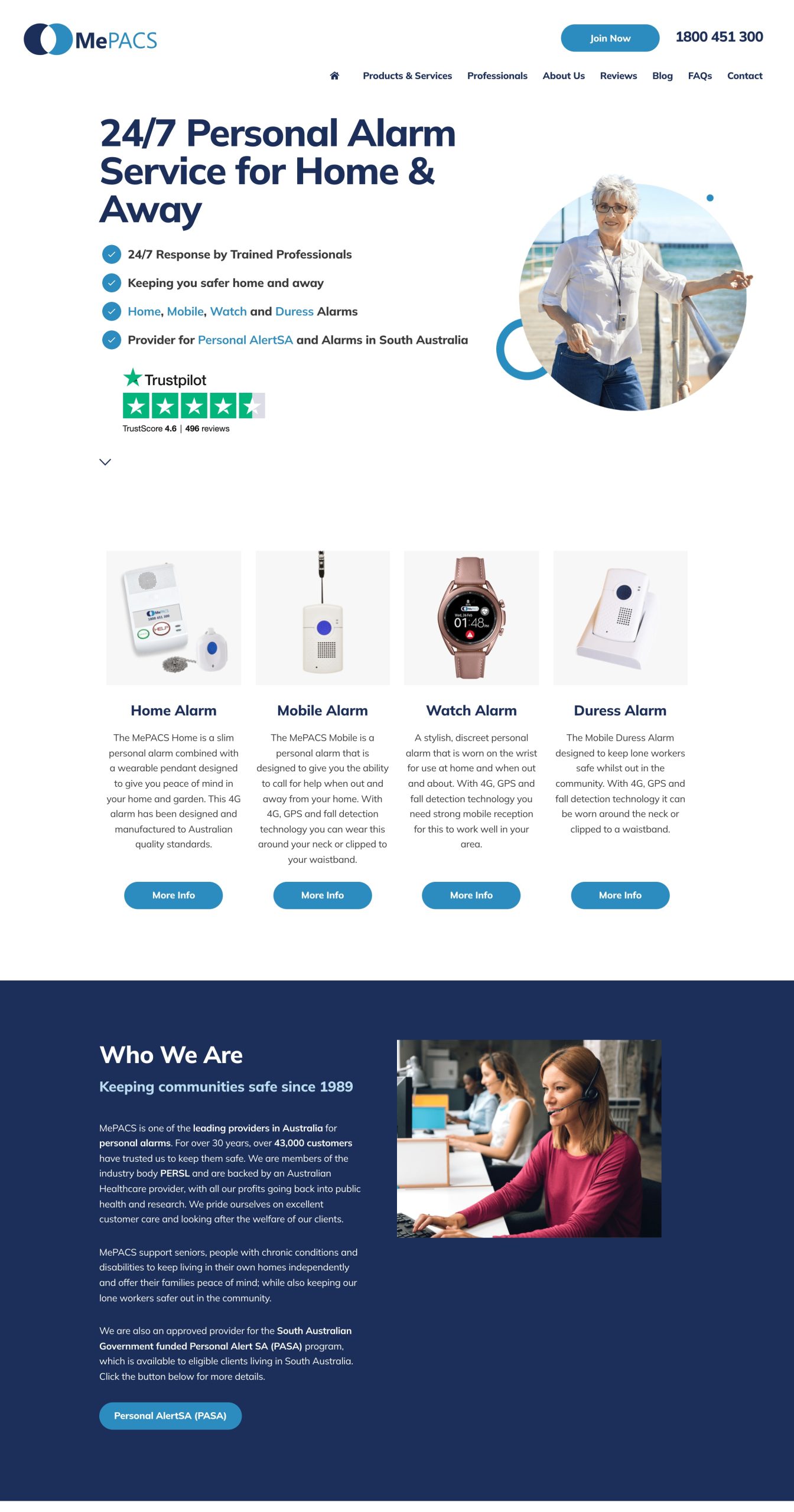
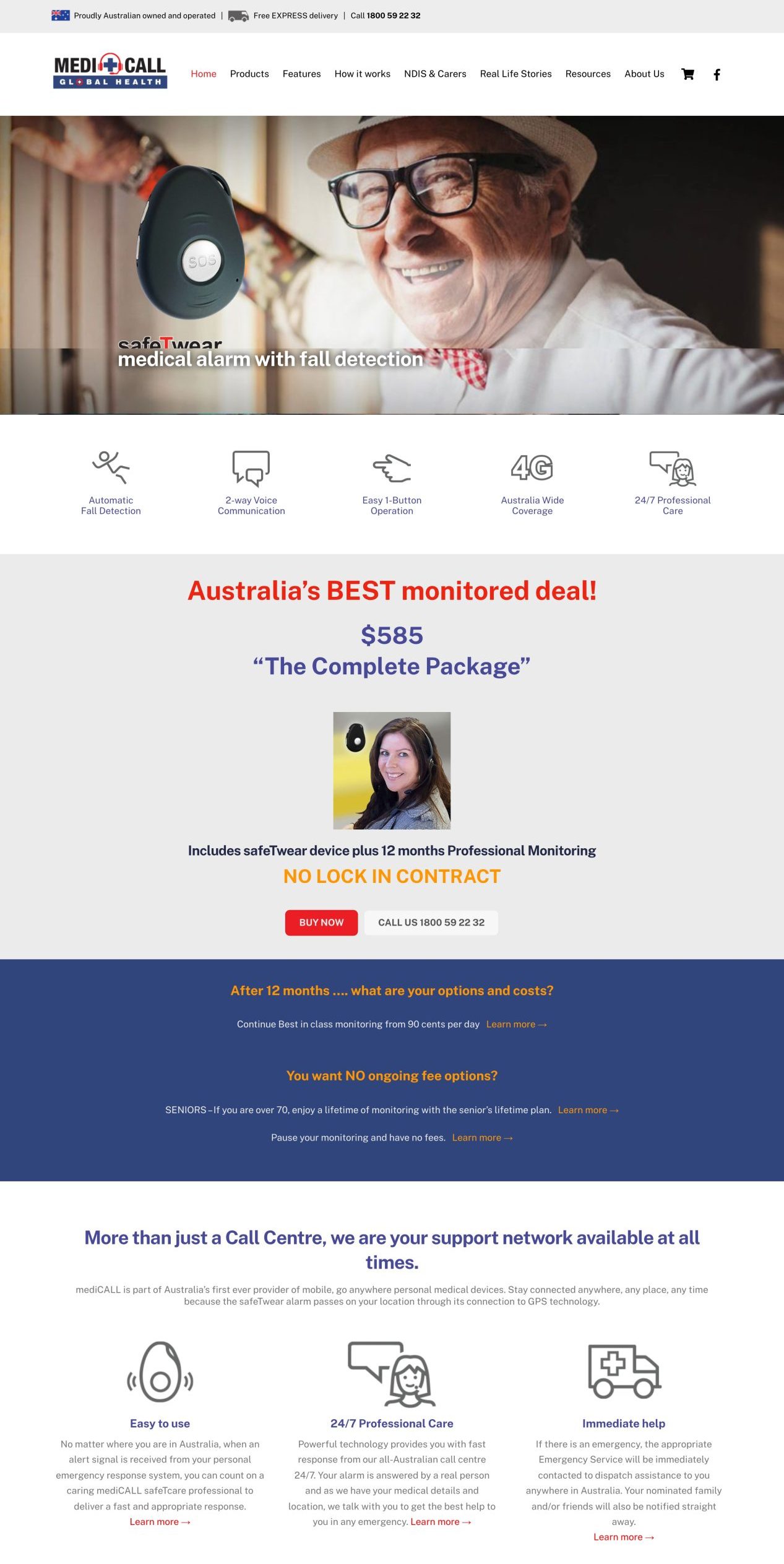

The conclusion was not that a few things needed adjusting.
It was that the brand had no credibility signals, no distinct identity, no findability for the terms its market was using, a website that people did not enjoy using on the device most of them arrived on and no measurement in place to tell anybody whether any change had worked. That is before you even consider that visually the whole segment were selling devices that looked similar in appearance, therefore brand perception became even more important.
So taken together, that is a foundation problem rather than a maintenance problem and the honest recommendation was to rebuild rather than make adjustments.
It was confronting for them to read about in my audit & it didn’t land well with the business owners. When I carry out a marketing audit I don’t soften the findings or the recommendations to leave out uncomfortable parts because it isn’t a diagnosis that will then help remedy a situation.
The implementation work was included in the same proposal, itemised and priced, at a website update of $1,200 to $2,000 and ongoing monthly work as a marketing retainer of $1,587 with a six month minimum. That is around $11,500 for a complete digital marketing programme to address paid advertising execution, SEO, conversion optimisation as well as product/brand positioning.
The advertising account had already spent more than $8,000 producing a conversion rate of under half a per cent, so the money required to address the causes was of the same order as the money already spent on the symptoms.
Ultimately they chose to try and do it themselves and didn’t engage me.
Effort without a foundation does not compound
Their trading history shows a pattern that predates me.
Sales came in bursts and each burst followed a large push of some kind but where nothing to do with the underlying business was being developed to make each burst more impactful. So they had to spend so much money to funnel a huge amount of people through in order to achieve their sub 1% conversion rate to a sale.
- January to February 2022 $24,000 up from $20,000 the previous year – it was their strongest of the three years I have figures for.
- March – May 2022 produced $4,095.
- January to February 2023 sales of around $5,000.
The refresh that changed nothing underneath
For several months after the audit I could see nothing changing on the site at all.
At around the six month mark a visual refresh appeared, the styling was tidier and some imagery had been replaced, and at a glance it looked like progress had been made. Although underneath all of that , every structural problem I had documented was still there, which is the same pattern I have described in the context of fixing half a website problem achieving nothing.
A refresh that changes what a site looks like without changing what it can be found for, what it measures, or how it performs on a phone is redecoration rather than an improvement, and it fits neatly into their burst pattern: a visible effort, no change to the foundation, no compounding.
The obvious next step, which is a second audit against the same measurements to establish whether the changes had done anything, was never requested. Without that comparison there was no way for anybody in the business to know whether the money spent on the refresh had bought them a single additional sale, or to separate a seasonal movement from a structural decline.
This is why the “revisit the real audit years later” work I do keeps producing the same answer, and it is the reason I now build a re-measurement point into how I frame this kind of engagement.
The principle worth taking from this digital marketing case study
I cannot claim that every aspect that my audit findings suggested would have created a stunning growth results because I was not engaged to implement anything, but most certainly my suggestions were focussed on getting the basics right which would have been a huge improvement over what was already executed and my other case studies are evidence of what is possible.
What I can say is that every mechanism behind the poor performance was named, measured, screenshot and written down in February 2022, and that none of them had been addressed.
Advice from people involved closely with the brand is nearly always polite and politically correct.
The reason to bring somebody in from outside is precisely that they have no history with the naming decision, no relationship with the developer, no stake in the pricing model and no attachment to the feature you have decided is your point of difference or whether the website looks good or not. What they bring instead is the ability to look at whether each of those things is producing a result, and to tell you when it is not as well as what to do to fix it.
That is also why a fixed scope audit exists as a separate thing from an ongoing engagement. The findings do not change based on whether you hire me afterwards, because the numbers say the same thing either way. The businesses that get value from it treat the document as a set of measurements to act on rather than a verdict to react to, then take the actions, then measure again to find out whether the actions worked.
If you are spending money on advertising and cannot trace it to sales, the useful first question is not whether the ads are any good. It is whether anything downstream of them is capable of turning a visitor into a customer, and that question has a factual answer you can get before you spend another dollar.
A one hour marketing consultation is usually enough to work out whether a full audit is warranted in your situation.